How Website Hosting Affects Google Rankings, Core Web Vitals & SEO
Introduction
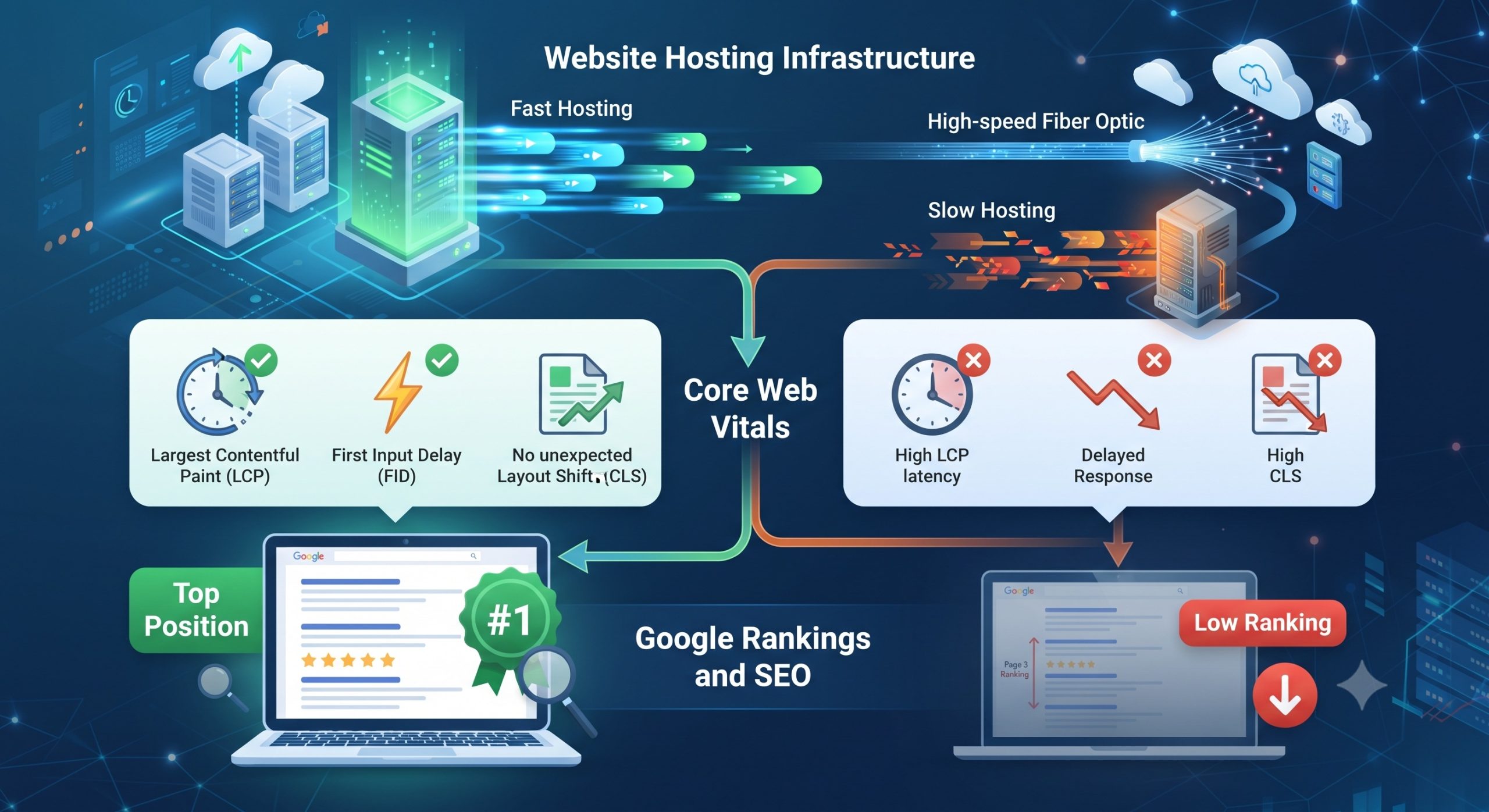
When businesses invest in SEO, they usually focus on keywords, content, backlinks, technical optimization and social media promotion. However, one important part of website performance is often overlooked: web hosting. The hosting environment behind a website can influence how quickly pages respond, how reliably a website stays online, how efficiently resources are delivered and how smoothly visitors interact with the site.
Website hosting is not a shortcut to higher Google rankings, and simply moving to a faster server does not guarantee a position on the first page of Google. Search visibility depends on many factors, including relevance, content quality, technical accessibility, links, user experience and other signals. However, hosting can affect several technical conditions that matter to SEO, especially website speed, Core Web Vitals, uptime, security and server responsiveness.
For businesses that depend on organic search traffic, these factors can have a meaningful impact on the overall performance of their digital presence. Choosing the right hosting infrastructure can therefore support a stronger SEO foundation while also improving the experience for visitors and customers.
What Is Web Hosting and Why Does It Matter for SEO?
Web hosting is the infrastructure that stores a website’s files, databases and applications and makes them available to visitors through the internet. Every time someone opens a webpage, their browser sends a request to the server hosting that website. The server processes the request and sends the required resources back to the visitor’s browser.
The quality of this process depends on several factors, including available CPU and RAM resources, storage technology, server configuration, network connectivity, database performance and the overall workload placed on the server. If the hosting environment is poorly configured, overloaded or insufficient for the website’s requirements, visitors may experience slow response times or interruptions.
From an SEO perspective, hosting matters because search engines need to access, crawl and process websites efficiently. More importantly, visitors expect websites to load quickly and respond smoothly. A technically strong hosting environment can help create the performance foundation required for a better user experience.
Parallax Hosting provides several hosting options, including web hosting, reseller hosting, cloud VPS servers and dedicated servers, allowing businesses to choose infrastructure according to their website and workload requirements.
How Website Speed Can Affect SEO
Website speed is one of the most visible connections between hosting and SEO. When a visitor clicks a search result, they expect the page to begin loading quickly. If the server takes too long to respond, the entire loading process can be delayed even before the browser starts rendering the page.
A slow website can create a poor user experience. Visitors may leave before reading the content, interacting with a product or completing a form. For an e-commerce website, this can mean lost sales. For a service business, it can mean fewer enquiries and leads.
Hosting is only one part of website speed, but it can influence server response and the delivery of website resources. A website with optimized code and compressed images can still perform poorly if its underlying infrastructure cannot efficiently handle the workload.
This is why businesses should consider hosting as part of their overall website performance strategy rather than treating it as a separate technical decision.
Understanding Google Core Web Vitals
Core Web Vitals are Google’s metrics for evaluating important aspects of real-world user experience. The current Core Web Vitals include Largest Contentful Paint (LCP), Interaction to Next Paint (INP), and Cumulative Layout Shift (CLS). Google has clarified that INP is now a Core Web Vital, replacing FID.
Largest Contentful Paint (LCP)
LCP measures loading performance by looking at how quickly the largest visible content element becomes rendered. This could be a large image, heading or other major page element.
Hosting can influence the early stages of the loading process because the browser needs to communicate with the server and retrieve resources. A responsive hosting environment can therefore contribute to a better loading experience, although factors such as image optimization, caching, CSS, JavaScript and page structure also play major roles.
Interaction to Next Paint (INP)
INP measures how responsive a webpage is when users interact with it. Clicking buttons, opening menus, selecting filters and interacting with forms can all involve browser-side processing.
Hosting does not directly control all aspects of INP because much of the metric depends on JavaScript execution in the browser. However, hosting contributes to the overall infrastructure delivering the website’s scripts and resources. Developers should therefore combine suitable hosting with efficient JavaScript and frontend optimization.
Cumulative Layout Shift (CLS)
CLS measures visual stability. A page has a poor experience when content unexpectedly moves while users are reading or interacting with it.
Hosting alone cannot solve every CLS problem. Layout shifts are commonly caused by images without defined dimensions, dynamically injected content, advertisements, fonts and other frontend elements. Nevertheless, reliable infrastructure helps ensure resources are delivered consistently while proper website development addresses the layout itself.
Does Better Hosting Directly Improve Google Rankings?
One of the most important questions businesses ask is whether upgrading their hosting will automatically increase their Google rankings.
The answer is no.
Better hosting does not guarantee higher rankings. Google evaluates many aspects of a website, and page experience is only one component of overall Search. A website can have excellent server performance but still struggle to rank if its content does not satisfy search intent, its pages are poorly optimized or its technical SEO has serious problems.
However, reliable hosting can support SEO by helping a website maintain good performance, accessibility and user experience. Think of hosting as part of the technical foundation rather than a ranking shortcut.
A useful SEO strategy combines high-quality content, search intent optimization, technical SEO, mobile usability, internal linking, structured data where appropriate, website security and strong performance.
The Connection Between Server Response Time and Website Performance
Before a webpage can display its content, the browser needs to communicate with the website’s server. The server then processes the request and begins delivering the necessary resources.
If the server is under heavy load or does not have sufficient resources, the initial response can take longer. This can contribute to slower page loading and create additional performance challenges.
For small websites with modest traffic, basic web hosting may be sufficient. As traffic, databases, applications or resource requirements grow, businesses may need more capable infrastructure.
Cloud VPS hosting can provide a more scalable environment for growing websites, while dedicated servers can provide significantly greater control and resources for demanding workloads. Parallax Hosting currently offers cloud VPS solutions with full root access and dedicated server solutions designed for resource-intensive applications.
How Hosting Resources Influence Website Performance
Different websites require different levels of infrastructure. A simple business website with a few pages has very different requirements from an online store containing thousands of products, a membership platform or a high-traffic web application.
CPU and RAM
CPU resources help process website requests, applications and database operations, while RAM allows systems to handle active processes efficiently. When a website consistently exceeds available resources, performance can suffer.
Storage Technology
Storage also matters. Faster storage can improve the speed at which website files and databases are accessed. Parallax Hosting’s dedicated server offerings include NVMe SSD storage on selected configurations, along with high-speed network connectivity and dedicated resources.
Network Connectivity
Even a well-optimized server needs reliable connectivity to deliver content efficiently. Network performance can influence how quickly resources travel between the server and visitors.
Scalability
A website may perform well during normal traffic but struggle during a marketing campaign, seasonal sale or viral traffic spike. Scalable infrastructure can help businesses prepare for changing workloads.
This is particularly important for e-commerce businesses, SaaS platforms and websites running advertising campaigns where sudden traffic increases can occur.
How Uptime Can Support SEO
Website availability is another important reason to take hosting seriously.
If your website repeatedly becomes unavailable, visitors cannot access your content, products or services. Extended technical problems can also interfere with crawling and create a poor experience for users.
Reliable hosting therefore helps maintain a consistent online presence. Businesses should look beyond a simple uptime percentage and consider the hosting provider’s infrastructure, monitoring, support, backup strategy and ability to respond when problems occur.
Parallax Hosting advertises a 99.9% uptime guarantee on its hosting offerings and provides 24/7 customer support.
Website Security and Its Relationship With SEO
Security is another important component of a healthy website.
An SSL certificate enables HTTPS encryption between a website and its visitors. HTTPS protects information transmitted between the browser and server and provides visitors with a secure connection.
Google treats HTTPS as a lightweight ranking signal, but security should not be viewed simply as an SEO tactic. HTTPS is important for protecting users, building trust and maintaining a professional online presence.
Parallax Hosting offers SSL certificates with options including DV, OV, EV and Wildcard SSL. Its SSL services provide HTTPS encryption and are designed to protect websites and their users.
Businesses should also make sure that their entire website consistently uses HTTPS and that HTTP versions redirect correctly to the secure version. Google provides specific guidance for HTTPS migrations and website infrastructure changes.
Why Hosting Matters More for E-Commerce Websites
E-commerce websites are particularly dependent on reliable hosting because they often combine product databases, high-resolution images, payment systems, customer accounts, search functions, filters, analytics and third-party integrations.
A slow product page can frustrate customers. A delayed checkout can cause abandoned purchases. A server that cannot handle a traffic spike during a sale can potentially result in lost revenue.
For this reason, e-commerce businesses should evaluate hosting based on actual workload rather than choosing a plan only because it has the lowest price.
Businesses should consider available resources, storage, database requirements, scalability, security, backups, technical support and expected traffic before selecting a hosting solution.
Shared Hosting vs VPS Hosting vs Dedicated Servers for SEO
The right hosting solution depends on the website rather than SEO alone.
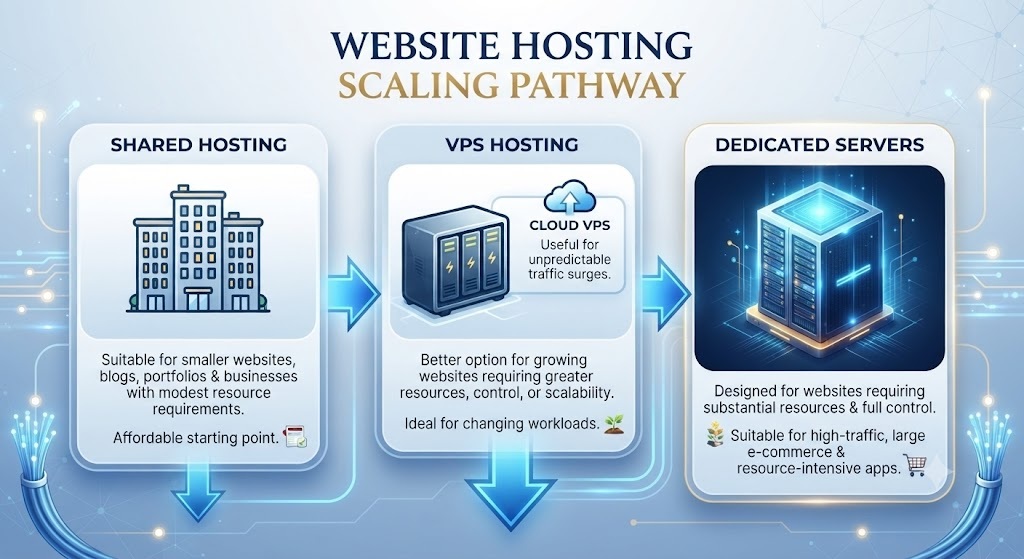
Parallax Hosting offers all three types of infrastructure through its web hosting, cloud VPS and dedicated server services, giving businesses multiple options as their requirements evolve.
How to Optimize Hosting for Better SEO Performance
Choosing a quality hosting provider is only the beginning. Businesses should also optimize the website itself.
Start by monitoring Core Web Vitals using tools such as Google Search Console and PageSpeed Insights. Identify pages with slow loading times, poor responsiveness or layout instability and investigate the underlying causes.
Compress large images and use modern image formats where appropriate. Remove unnecessary plugins and scripts that increase page weight or processing requirements. Implement caching where suitable and optimize databases for websites that depend heavily on dynamic content.
A Content Delivery Network can also help distribute static resources closer to users in different geographic locations. For businesses serving audiences across multiple regions, CDN configuration can complement a well-optimized hosting environment.
Website owners should also keep their CMS, plugins, themes, frameworks and server software updated. Outdated software can create security and performance issues.
How to Choose the Right Hosting Provider for SEO
When selecting web hosting, do not judge providers solely by price. Consider the complete infrastructure and support ecosystem.
Look for reliable uptime, suitable CPU and RAM resources, fast storage, strong network connectivity, scalable hosting options, security features, backups, monitoring and responsive technical support.
You should also evaluate whether the provider offers a hosting plan that can grow with your website. A business may begin with standard web hosting and eventually require VPS or dedicated infrastructure as traffic and application complexity increase.
Parallax Hosting provides web hosting, reseller hosting, cloud VPS and dedicated servers, along with SSL and support services, allowing businesses to select infrastructure based on their specific requirements.
Common Hosting Mistakes That Can Hurt Website Performance
One of the most common mistakes is choosing hosting exclusively based on the lowest price. While affordable hosting can be useful for small websites, insufficient resources can become a problem as traffic and functionality increase.
Another mistake is ignoring server resources. Website owners should monitor CPU, RAM, storage and bandwidth usage rather than waiting until visitors report that the website is slow.
Using outdated software is another common problem. CMS platforms, plugins and server components should be maintained regularly.
Businesses should also avoid assuming that hosting alone will fix every performance issue. A slow website can be caused by oversized images, inefficient code, excessive JavaScript, poor database queries, third-party scripts or inadequate caching.
The best results come from combining quality hosting with technical SEO and website optimization.
Hosting, SEO and User Experience Work Together
Modern SEO is not simply about adding keywords to webpages. Search engines aim to provide users with useful and relevant results, while businesses need websites that turn visitors into customers.
This makes user experience increasingly important.
Imagine two websites offering similar services. One loads quickly, works smoothly on mobile devices and provides secure navigation. The other takes several seconds to respond, contains layout shifts and occasionally becomes unavailable.
Even if both websites publish good content, the first website provides a stronger overall digital experience.
Hosting cannot replace good content or SEO strategy, but it can provide the infrastructure required to deliver that strategy effectively.
A Practical SEO Hosting Checklist
Before choosing or upgrading hosting, businesses should evaluate:
- Website traffic and expected future growth
- CPU and RAM requirements
- Storage type and capacity
- Server response performance
- Network connectivity
- Uptime and reliability
- SSL and HTTPS support
- Backup options
- Security features
- Scalability
- Technical support
- Server location and target audience
- Caching and CDN compatibility
- Database requirements
- CMS and application requirements
Review these factors regularly because hosting requirements can change as a website grows.
Final Thoughts
Website hosting and SEO are more closely connected than many businesses realize. Hosting does not directly guarantee better Google rankings, but it can influence the technical environment in which a website operates.
Reliable hosting can support faster server responses, consistent availability, secure HTTPS connections and a better overall user experience. These factors work alongside content quality, technical SEO, mobile optimization and other ranking considerations.
Core Web Vitals make website experience even more important. LCP, INP and CLS provide useful ways to evaluate how real users experience a website, but businesses should remember that improving these metrics requires more than simply changing hosting providers.
For smaller websites, a well-configured web hosting plan may be enough. Growing websites may benefit from cloud VPS infrastructure, while demanding applications and high-traffic businesses may require dedicated servers.
The key is to choose hosting based on your website’s actual requirements and combine reliable infrastructure with strong SEO, high-quality content, technical optimization and continuous performance monitoring.
If your business website is growing, investing in the right hosting infrastructure can be an important step toward creating a faster, more reliable and secure digital experience.
Explore Parallax Hosting‘s web hosting, Cloud VPS and dedicated server solutions to find infrastructure suited to your website’s performance and growth requirements.