Web Development October 13, 2026 Namrata J. 91

How Website Automation Saves Time and Improves Business Efficiency

How Website Automation Saves Time and Improves Business Efficiency

In today’s fast-moving digital world, businesses need to manage multiple activities simultaneously, from updating website content and responding to customer inquiries to processing orders, monitoring performance, and maintaining security. Performing every task manually can consume valuable time, increase the risk of errors, and slow business growth.

This is where website automation becomes valuable.

Website automation helps businesses automate repetitive online tasks using software, integrations, scheduled processes, and AI-powered tools. From automated customer emails to website backups and lead management, automation can simplify daily operations and help teams focus on more important business activities.

For startups, e-commerce businesses, agencies, and growing companies, website automation is becoming an important part of digital transformation.

In this guide, we will explore what website automation is, how it works, its key benefits, practical use cases, and how the right hosting infrastructure can support an efficient and reliable automated website.

What Is Website Automation?

Website automation is the use of software, scripts, integrations, and automated workflows to perform website-related tasks with minimal manual intervention.

Instead of completing the same activity repeatedly, businesses can configure systems to perform tasks automatically when a specific event occurs or at a scheduled time.

For example, an e-commerce website can automatically send an order confirmation after a customer completes a purchase. A business website can capture a visitor’s contact details and add them to a customer relationship management (CRM) system. A website administrator can schedule content publication or configure automated backups.

Common website automation activities include:

  • Automated email notifications
  • Contact form submissions and lead collection
  • Scheduled blog publishing
  • E-commerce order processing
  • Customer support chatbots
  • Website monitoring and alerts
  • Automated backups
  • Performance reporting
  • Security notifications
  • CRM and marketing integrations

The main objective is simple: reduce repetitive manual work while improving consistency, productivity, and operational efficiency.

Why Is Website Automation Important for Businesses?

As a business grows, its digital operations often become more complicated. More customers mean more inquiries, more transactions, more content, and more data to manage.

Without automation, employees may spend hours handling repetitive tasks that could be managed by reliable software workflows.

Website automation helps businesses create more organized processes and reduce unnecessary administrative work.

For example, a digital marketing agency managing multiple clients may automate lead notifications, reporting, appointment reminders, and content scheduling. An online store may automate order confirmations, shipping updates, and inventory alerts.

Automation can help businesses:

  • Save time on repetitive activities
  • Reduce avoidable human errors
  • Respond to customers more consistently
  • Improve workflow efficiency
  • Manage increasing workloads
  • Organize customer information
  • Support business growth without adding the same amount of manual work

Automation does not eliminate the need for human oversight. Instead, it allows employees to focus on decision-making, customer relationships, creativity, and other activities that require human judgment.

1. Automate Customer Emails and Notifications

Email automation is one of the most practical ways to improve website efficiency.

Manually sending an email after every inquiry, purchase, or registration can become difficult as customer activity increases.

Automated email workflows can send relevant messages when a customer completes a particular action.

For example:

  • A welcome email after account registration
  • An inquiry confirmation after a contact form submission
  • An order confirmation after a purchase
  • A password reset email when requested
  • An appointment reminder before a scheduled meeting
  • A follow-up email after a service inquiry

These workflows help customers receive timely information without requiring an employee to send every message manually.

Businesses can also use email automation to organize newsletters, onboarding sequences, and customer follow-ups.

However, promotional email automation should follow applicable privacy, consent, and unsubscribe requirements.

Business benefit: Faster communication, fewer repetitive tasks, and a more consistent customer experience.

2. Automate Lead Generation and Customer Management

Generating website traffic is important, but converting visitors into potential customers is equally valuable.

Without an organized process, leads can get lost in inboxes or remain unanswered for too long.

Website automation can connect contact forms, landing pages, CRM platforms, and email systems to create a more efficient lead management process.

Consider this example:

  1. A visitor fills out a contact form.
  2. The website validates the submitted information.
  3. The lead is recorded in a CRM or another approved system.
  4. The sales team receives a notification.
  5. The visitor receives an acknowledgment email.
  6. A follow-up task is assigned to the appropriate team member.

This workflow reduces manual data entry and helps businesses respond to inquiries more consistently.

For service providers, agencies, and B2B companies, this can make lead management significantly more organized.

Businesses should also implement spam protection, secure data handling, and access controls to protect customer information.

Business benefit: Better lead organization, fewer missed inquiries, and a more structured sales process.

3. Schedule Website Content Automatically

Content marketing plays an important role in search engine optimization (SEO), customer education, and brand visibility.

However, regularly publishing articles, updating website pages, and maintaining a content calendar requires planning.

Content scheduling tools allow businesses to prepare content in advance and publish it automatically at specified times.

Many content management systems, including WordPress, support scheduled publishing.

Businesses can use content automation to:

  • Schedule blog posts
  • Publish planned announcements
  • Organize editorial calendars
  • Update selected website content
  • Send notifications when new content is published
  • Coordinate content workflows between team members

For example, a company can prepare four blog posts at the beginning of the month and schedule them for weekly publication.

This makes content production more predictable and reduces the need for last-minute publishing.

Automation should still include human review. Articles need accurate information, useful insights, original content, and appropriate SEO optimization.

Business benefit: More consistent publishing and less manual content management.

4. Improve E-Commerce Operations With Automation

E-commerce websites involve numerous repetitive processes, from order management to customer communication.

As order volumes grow, handling these activities manually can become inefficient.

Automation can connect different parts of an online store and help processes run more smoothly.

Common e-commerce automation examples include:

  • Order confirmation emails
  • Shipping status notifications
  • Low-stock alerts
  • Abandoned-cart reminders
  • Invoice generation
  • Customer review requests
  • Return request notifications
  • Inventory synchronization

For instance, when a product’s stock falls below a defined threshold, an automated notification can alert the inventory manager.

Similarly, after an order is placed, the store can send a confirmation email and update the order status in its management system.

These workflows help reduce administrative work and improve the customer experience.

However, payment processing, refunds, inventory updates, and order fulfillment should include appropriate validation, error handling, and human review for exceptional cases.

Business benefit: More organized operations, fewer repetitive administrative tasks, and improved order communication.

5. Use AI Chatbots to Support Website Visitors

AI-powered chatbots are increasingly used to help website visitors find information and navigate services.

A chatbot can answer common questions, explain basic service details, direct users to relevant pages, and collect information for follow-up.

For example, a hosting company could use a chatbot to guide visitors toward information about domain registration, hosting plans, SSL certificates, or technical support resources.

Depending on the implementation, chatbots can also:

  • Answer frequently asked questions
  • Provide basic troubleshooting guidance
  • Collect sales inquiries
  • Recommend relevant documentation
  • Route complex requests to human support
  • Operate outside normal business hours

AI chatbots should not be treated as infallible. Their answers need to be monitored, especially when they provide technical guidance or discuss billing and account-specific information.

Businesses should also make it easy for visitors to contact a human when necessary.

Business benefit: Faster access to information and reduced pressure on teams handling repetitive questions.

6. Automate Website Backups and Monitoring

Website performance and availability are important for business continuity.

A website outage, accidental deletion, software update problem, or security incident can disrupt normal operations.

Automation can help businesses detect problems and maintain recovery options.

Automated backups

Scheduled backups can create copies of website files, databases, or other important information.

A useful backup strategy should include appropriate retention periods, secure storage, and regular restoration tests. Keeping every backup on the same server may not provide sufficient protection against server failure or compromise.

Website uptime monitoring

Monitoring services can periodically check whether a website is responding and alert administrators when a problem is detected.

Performance monitoring

Automated checks can help identify slow response times, resource limitations, or other performance issues.

Security notifications

Depending on the tools and configuration, security systems can alert administrators about suspicious activity, failed login attempts, or detected vulnerabilities.

Automation does not guarantee that a website will never experience downtime. Its value lies in helping teams identify problems earlier and respond more consistently.

Business benefit: Better visibility, improved preparedness, and more efficient website maintenance.

7. Connect Website Tools Through Automated Workflows

Many businesses use separate platforms for their websites, email, CRM, marketing, analytics, and project management.

When these tools do not communicate effectively, employees may need to copy information between systems manually.

Integration tools and APIs can connect compatible applications and trigger actions automatically.

For example:

Website form → CRM → Email notification → Follow-up task

Another workflow might look like this:

New blog published → Social media scheduling tool → Team notification

Businesses can use workflow automation platforms, native integrations, or custom API connections depending on their requirements.

Before implementing an integration, check the availability of supported connectors, subscription costs, data permissions, and security requirements.

Not every task needs automation. The best workflows solve a real operational problem without creating unnecessary complexity.

Business benefit: Less duplicate data entry, better coordination, and more connected business processes.

8. How Website Automation Improves Business Efficiency

Website automation can improve business efficiency in several ways.

Saves employee time

Automated workflows reduce the amount of time spent on repetitive activities, allowing employees to concentrate on higher-value work.

Improves consistency

A properly configured workflow follows defined rules each time it runs, helping businesses standardize routine processes.

Reduces manual errors

Automation can reduce errors associated with repeated data entry and manual task execution. It still requires testing and validation to prevent errors from spreading automatically.

Supports faster communication

Automated notifications and confirmations can help customers receive timely updates.

Helps manage business growth

A well-designed workflow can handle increasing activity without requiring every additional task to be completed manually.

Improves operational visibility

Logs, reports, alerts, and workflow dashboards can help teams identify bottlenecks and understand how processes are performing.

The actual benefits depend on the workflow, the quality of the implementation, and how often the automated task is performed.

9. The Role of Web Hosting in Website Automation

Automation requires more than software. It also depends on the website infrastructure that runs applications, processes requests, stores data, and connects with external services.

The right hosting environment can help automated workflows operate reliably.

Web hosting

Suitable for many small business websites, blogs, and standard WordPress installations with modest automation requirements.

VPS hosting

Can offer greater control over server configuration and resources for applications with more demanding workloads or specialized requirements.

Dedicated servers

May be appropriate for resource-intensive applications, larger workloads, or organizations requiring dedicated physical server resources.

The correct option depends on the website, its traffic, the software being used, and the amount of processing required.

Businesses should evaluate the following before choosing hosting for automation:

  • CPU and memory requirements
  • Storage capacity and performance
  • Database performance
  • Supported programming languages and software
  • Scheduled task or cron job support
  • API connectivity
  • Security and access controls
  • Backup and recovery options
  • Monitoring and technical support
  • Upgrade and scaling options

For example, a simple scheduled blog post may require very few resources. A workflow that processes large datasets, synchronizes inventory, or runs frequent background jobs may require more careful resource planning.

The key takeaway: Reliable hosting provides a foundation for website automation, but the automation software itself must also be designed and configured correctly.

10. Best Practices for Implementing Website Automation

Businesses should start with a clear plan instead of automating every task at once.

Follow these practical steps.
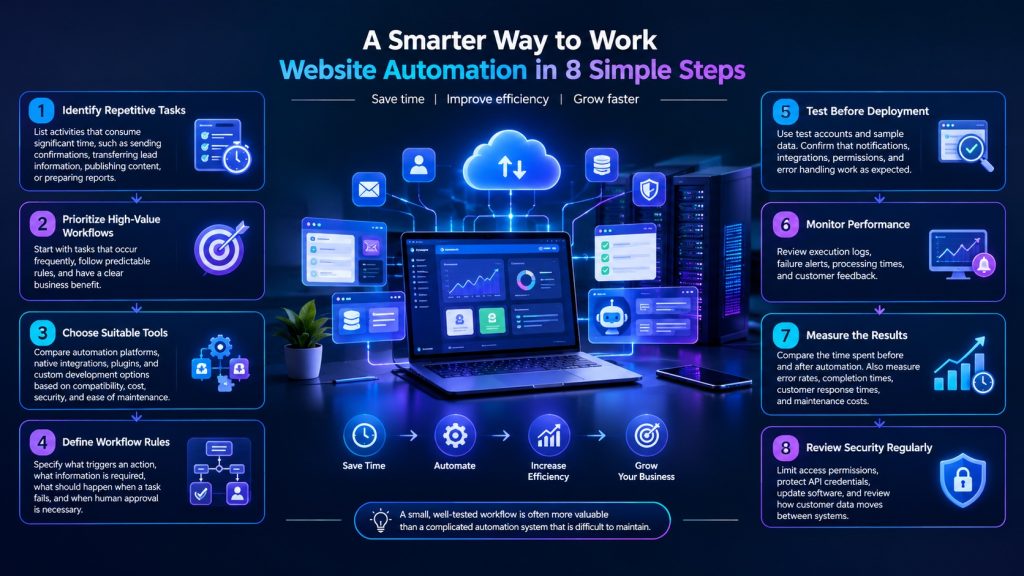
"A Smarter Way to Work: Website Automation in 8 Simple Steps," featuring a laptop dashboard surrounded by glowing tech icons. It outlines eight steps: identifying repetitive tasks, prioritizing workflows, choosing tools, defining rules, testing, monitoring, measuring results, and reviewing security.

11. Common Website Automation Mistakes to Avoid

Automation can create problems when it is implemented without adequate planning.

Avoid these common mistakes:

  • Automating an inefficient process without improving it first
  • Choosing tools that do not integrate with existing systems
  • Failing to test workflows before launch
  • Ignoring error notifications and execution logs
  • Giving automation tools unnecessary permissions
  • Sending excessive or irrelevant automated emails
  • Depending on automation without a backup plan
  • Publishing unreviewed AI-generated content
  • Failing to monitor costs as usage increases
  • Leaving workflows unmaintained after software changes

Automation should make business processes easier to manage, not create another layer of complexity.

Review automated workflows regularly to ensure they remain accurate, secure, useful, and cost-effective.

The Future of Website Automation

Website automation is evolving as AI, cloud computing, APIs, and connected business applications become more accessible.

Businesses are increasingly able to combine traditional rule-based automation with AI-assisted processes.

Rule-based automation is useful when an action follows a predictable condition, such as sending a confirmation after a form submission.

AI-assisted automation may help with tasks such as classifying customer inquiries, summarizing information, or routing support requests based on their content.

However, AI-generated results may be inaccurate, and sensitive or high-impact decisions often require human review.

Cloud infrastructure can also help businesses run applications and background workloads, while monitoring and integration tools provide greater visibility into digital operations.

The future is not about automating every human activity. It is about combining technology with human expertise to make business processes more efficient.

Companies that approach automation strategically can build more consistent workflows and create a stronger foundation for digital growth.

How Parallax Hosting Can Support Your Digital Business

At Parallax Hosting, we understand that a successful online business needs more than an attractive website. It also needs a reliable foundation for performance, security, and growth.

Whether you manage a company website, publish a blog, operate an online store, or develop a resource-intensive application, choosing suitable hosting is an important part of your digital strategy.

Parallax Hosting offers services including:

  • Web Hosting
  • VPS Hosting
  • Dedicated Server Hosting
  • Reseller Hosting
  • Domain Registration
  • Business Email
  • SSL Certificates

As your website and automated workflows grow, your infrastructure requirements may change. Selecting an appropriate hosting solution and reviewing your resource needs can help you prepare for those changes.

Ready to build a stronger digital foundation for your business?

Explore Parallax Hosting and choose a hosting solution that fits your website, workload, and growth plans.

Conclusion

Website automation is a practical way to reduce repetitive work, improve consistency, and make business operations more efficient.

From automated emails and lead management to content scheduling, e-commerce workflows, website monitoring, and AI chatbots, automation can simplify many everyday digital tasks.

The best results come from choosing the right workflows, testing them carefully, protecting customer data, and measuring their impact.

Just as importantly, automated websites need suitable infrastructure to support their applications, integrations, and processing requirements.

Automate repetitive tasks. Improve your workflows. Focus on business growth.

With the right automation strategy and hosting foundation, your business can spend less time managing routine tasks and more time creating value for customers.

Frequently Asked Questions

What is website automation?

Website automation uses software, scripts, integrations, and scheduled workflows to perform repetitive website-related tasks with minimal manual intervention.

How does website automation save time?

It reduces the need to manually complete recurring tasks such as sending emails, managing leads, publishing content, processing routine orders, and generating reports.

What are examples of website automation?

Examples include automated email notifications, lead capture, scheduled publishing, e-commerce order updates, chatbots, website backups, uptime monitoring, and CRM integrations.

Is website automation suitable for small businesses?

Yes. Small businesses can start with simple workflows such as contact form notifications, appointment reminders, scheduled blog posts, and automated backups.

How does AI help with website automation?

AI can assist with tasks such as classifying customer inquiries, summarizing information, supporting chatbots, and routing requests. AI outputs should be monitored and reviewed when accuracy is important.

Does website automation require special hosting?

Not always. Basic automation may work with standard web hosting. More demanding applications, background processing, or specialized configurations may benefit from VPS or dedicated server hosting, depending on the requirements.

Is website automation secure?

It can be secure when implemented correctly. Businesses should use appropriate permissions, protect credentials, maintain software updates, monitor activity, and follow applicable data protection requirements.

How can I measure the success of website automation?

Measure time saved, task completion rates, error rates, response times, operating costs, and customer satisfaction. Compare these metrics with the results before automation was introduced.


Namrata J.
The Author

Namrata J.

Related posts

13 October
How Website Automation Saves Time and Improves Business Efficiency

In today’s fast-moving digital world, businesses need to manage multiple activities simultaneously, from updating website content and responding to customer inquiries to processing orders, monitoring performance, and maintaining security. Performing every task manually can consume […]

Read more
91 comment 0 By Namrata J.
06 August
How Ultimate Web Development Investment Pays Off in 2026

Introduction In 2026, having a website is no longer enough. It must be fast, secure, and mobile-friendly, and designed to convert visitors into customers for web development. Moreover, your website is often the first interaction […]

Read more
192 comment 0 By Namrata J.
20 March
Mastering Responsive Web Design: Creating Classes for a CSS File

Introduction: In today’s digitally driven world, the significance of responsive web design cannot be overstated. With an array of devices accessing the internet, ensuring your website looks impeccable across all screen sizes is paramount. Cascading […]

Read more
1310 comment 0 By Udit Nag
Technology October 06, 2026 Namrata J. 112

From Aichi-Nagoya 2026 to the Digital Future: How Cloud Technology Is Powering Global Sports

From Aichi-Nagoya 2026 to the Digital Future: How Cloud Technology Is Powering Global Sports

The Aichi-Nagoya 2026 Asian Games have shown how modern sports are becoming increasingly connected with technology.

Held in Japan from September 19 to October 4, 2026, the 20th Asian Games brought athletes and teams from across Asia together across a major multi-sport event. The official Games platform currently lists 43 sports and 54 venues, while the Olympic Council of Asia lists 45 participating National Olympic Committees.

But today’s major sporting events are no longer experienced only inside stadiums.

Fans follow schedules online, check results on digital platforms, consume video and social media content, access mobile services and share moments instantly around the world.

Behind that experience is a complex technology ecosystem involving connectivity, cloud computing, artificial intelligence, data processing, cybersecurity, high-performance infrastructure and scalable digital platforms.

And the lessons from Aichi-Nagoya 2026 extend far beyond sports.

For businesses building websites, e-commerce platforms, applications and online services, the same principle applies:

Digital growth requires infrastructure that can keep up with demand.

The Digital Transformation of Global Sports

Sports technology has evolved dramatically.

A major sporting event today generates enormous amounts of digital information. Competition results, schedules, athlete information, photographs, video content, venue information and news updates all need to reach audiences quickly.

The Aichi-Nagoya 2026 official platform provides digital access to competition information, venues, sports and ongoing Games content.

At the same time, telecommunications infrastructure plays an important role in connecting venues and enabling communication.

NTT, NTT West and NTT DOCOMO announced their partnership for the Games, with NTT West providing competition communication networks at venues as well as broadcast communication networks, while NTT DOCOMO worked on enhancing wireless communication quality at venues.

This illustrates an important reality:

The sporting event may happen on the field, but the digital experience depends on infrastructure behind the scenes.

1. Why Cloud Technology Matters in Modern Sports

Cloud computing has changed how organizations build and operate digital services.

Instead of relying only on fixed physical infrastructure, cloud environments can provide access to computing, storage and networking resources that can be adjusted according to workload.

This is particularly valuable for major events where demand can change rapidly.

Consider what happens when a major final begins.

Thousands or millions of people may simultaneously want to:

  • Check live scores
  • View competition schedules
  • Read breaking news
  • Watch video content
  • Check medal standings
  • Search athlete information
  • Share content on social media
  • Access mobile services

This creates a sudden increase in digital demand.

A scalable infrastructure strategy can help organizations prepare for these changing workloads.

For businesses, the same situation occurs during:

  • Product launches
  • Online sales
  • Viral campaigns
  • Marketing campaigns
  • Breaking-news events
  • Seasonal traffic
  • Influencer promotions

Cloud technology therefore isn’t only relevant to global sporting events.

It is increasingly relevant to any business whose digital audience can grow quickly.

2. Aichi-Nagoya 2026 Shows Why Connectivity Matters

A major sporting event requires more than stadiums and sporting equipment.

It requires communication systems capable of supporting athletes, organizers, media, staff and spectators.

For Aichi-Nagoya 2026, NTT Group’s official partnership included communication infrastructure for competition venues and broadcasting.

The organizing committee also issued information regarding free Wi-Fi at certain venues, explaining that large numbers of wireless devices associated with the Games required careful management of the radio-frequency environment.

This provides a useful lesson for businesses:

Connectivity is infrastructure.

A website may have excellent design and content, but without reliable networking and hosting infrastructure, users may still experience slow responses or interruptions.

As businesses become more dependent on digital platforms, reliable connectivity becomes part of the customer experience.

3. AI Is Becoming a Major Part of the Sports Technology Ecosystem

Artificial intelligence is one of the biggest technology trends shaping sports in 2026.

AI can potentially support areas such as:

  • Data analysis
  • Athlete performance insights
  • Content creation
  • Personalization
  • Search and recommendations
  • Operational decision-making
  • Computer vision
  • Fan engagement

The growing relationship between AI and sports technology was highlighted during Aichi-Nagoya 2026.

On September 20, Lenovo and the Olympic Council of Asia announced a partnership focused on technology-enabled sport. The organizations said they would explore opportunities for AI to help manage complex operations, support faster decision-making and create more connected experiences for fans.

This is an important shift.

AI is not simply becoming another software feature.

It is increasingly becoming part of the infrastructure and decision-making layer behind digital experiences.

4. AI Needs Powerful Infrastructure

AI-powered applications can require significant computing resources.

Depending on the application, organizations may need:

  • High-performance processors
  • Large amounts of memory
  • Fast storage
  • High-speed networking
  • Scalable computing
  • Reliable databases
  • Secure infrastructure

This creates a growing connection between AI and cloud infrastructure.

A company developing an AI-powered application may start with relatively modest requirements.

But as users increase, the amount of data being processed can grow significantly.

The infrastructure therefore needs to evolve alongside the application.

This is why businesses should think about scalability when selecting hosting infrastructure.

5. High-Performance Hosting Is Becoming More Important

Website speed has always mattered, but the importance of performance continues to increase as websites become more sophisticated.

Modern websites can include:

  • High-resolution images
  • Videos
  • Interactive applications
  • Customer portals
  • APIs
  • Databases
  • Analytics tools
  • AI features
  • E-commerce functionality

Every additional component can increase infrastructure requirements.

High-performance hosting can help provide the computing and storage resources needed for demanding workloads.

Technologies such as NVMe SSD storage, optimized server configurations, caching and high-speed networking can contribute to a faster and more responsive digital environment.

For businesses, this can translate into a better experience for visitors and customers.

6. Real-Time Information Requires Reliable Systems

One of the biggest changes in sports consumption is the move toward real-time information.

Fans don’t necessarily wait for a television broadcast or newspaper report.

They want information immediately.

A user may want to know:

Who won?

What is the current score?

Who is leading the medal table?

When is the next event?

Where is the competition taking place?

These seemingly simple questions depend on multiple systems working together.

A simplified architecture could look like this:

Data Source → API → Database → Application → CDN → User

If one component becomes overloaded or unavailable, the final user experience can suffer.

The same architecture can apply to business applications.

For example:

  • Online booking platforms
  • E-commerce websites
  • Financial dashboards
  • SaaS applications
  • Customer portals
  • Inventory systems

As the requirement for real-time information grows, infrastructure reliability becomes increasingly important.

7. Cybersecurity Is Essential in a Connected Sports World

More connectivity also creates more opportunities for cyber threats.

Major digital platforms can potentially face:

  • DDoS attacks
  • Malware
  • Credential attacks
  • Bot traffic
  • Unauthorized access
  • Data breaches
  • Vulnerability exploitation

Security therefore needs to be considered at every layer.

Businesses should pay attention to:

SSL/TLS

Encrypt communication between users and websites.

Firewalls

Help control and filter unwanted network traffic.

Secure authentication

Protect accounts and administrative systems.

Backups

Provide recovery options when data is lost or compromised.

Monitoring

Help identify unusual activity and infrastructure problems.

Software updates

Reduce exposure to known vulnerabilities.

A secure website is not simply a technical requirement.

It is also a trust requirement.

8. Scalability: The Most Important Lesson for Businesses

Perhaps the biggest lesson businesses can take from large sporting events is scalability.

A website doesn’t necessarily need enormous infrastructure today.

But what happens tomorrow?

Imagine a small online business receiving 1,000 visitors per day.

A successful marketing campaign suddenly sends 20,000 visitors.

If the hosting environment was designed only for the original traffic level, the website could become slow or unavailable.

The problem is not the marketing campaign.

The problem is that the infrastructure wasn’t prepared for success.

This is why businesses should consider their future requirements, not just their current traffic.

Scalable hosting can provide a stronger foundation for growth.

9. What Asian Games 2026 Can Teach E-Commerce Businesses

E-commerce businesses can learn a particularly important lesson from major sporting events.

Traffic is unpredictable.

A product can suddenly go viral.

A discount can generate thousands of visitors.

An influencer can drive a huge amount of traffic.

A festive sale can create an enormous increase in demand.

At that moment, the website needs to remain available.

Imagine spending heavily on:

  • Google Ads
  • Meta Ads
  • SEO
  • Influencer marketing
  • Social media
  • Content marketing

And then losing customers because the website becomes slow.

That is why marketing and hosting should not be treated as completely separate decisions.

Marketing generates demand.

Hosting infrastructure helps your website handle that demand.

10. Cloud Hosting and the Future of Digital Business

The future of digital business is increasingly connected to cloud technology.

Organizations are adopting cloud infrastructure because it can provide flexibility for changing workloads and digital services.

For businesses, cloud-based infrastructure can support:

  • Website growth
  • Application deployment
  • Data processing
  • E-commerce
  • Remote operations
  • AI applications
  • Business continuity
  • Scalable digital services

The key benefit is flexibility.

A business doesn’t remain the same size forever.

Its traffic changes.

Its customers change.

Its applications change.

Its data grows.

Its infrastructure therefore needs to evolve.

11. From Global Sports to Local Businesses

You don’t have to operate a global sporting event to benefit from the lessons of Aichi-Nagoya 2026.

A local business website can face many of the same fundamental challenges.

A restaurant can suddenly receive thousands of visitors after a viral social media post.

A startup can experience rapid traffic growth after receiving media coverage.

An e-commerce store can receive a massive traffic spike during a sale.

A content creator can suddenly attract millions of views.

The scale is different.

The infrastructure principles are similar.

Performance.

Security.

Reliability.

Scalability.

These are becoming fundamental requirements for modern digital businesses.

12. Why Choosing the Right Hosting Provider Matters

Choosing a hosting provider shouldn’t be based only on price.

Businesses should also consider:

  • Server performance
  • Storage technology
  • Scalability
  • Security
  • Network reliability
  • Backup options
  • Technical support
  • Uptime commitments
  • Resource availability
  • Upgrade options

The right hosting environment depends on the business.

A personal blog may have completely different requirements from an e-commerce store.

A high-traffic website may need different infrastructure from a small business website.

An AI application may have significantly higher computing requirements than a standard WordPress site.

The best hosting solution is therefore the one that matches the workload.

How Parallax Hosting Supports the Digital Future

At Parallax Hosting, we believe hosting should be more than simply providing server space.

Modern businesses need infrastructure designed around performance, security, reliability and growth.

Whether you’re launching a website, growing an online store, managing a business website or building a demanding application, your hosting infrastructure is an important part of your digital foundation.

Parallax Hosting offers solutions including:

As technology continues to evolve, your infrastructure should be ready to evolve with it.

Your next traffic spike, campaign, customer or opportunity could be just one click away.

Choose infrastructure that’s ready for what’s next.

Final Thoughts

Aichi-Nagoya 2026 demonstrates how modern sports are becoming increasingly dependent on digital technology.

The event’s technology ecosystem involves connectivity, communication networks, digital platforms and an emerging focus on AI-enabled experiences.

But the bigger lesson extends beyond sports.

Whether you’re operating a global sporting event or a growing online business, digital success depends on having infrastructure that can handle today’s requirements while preparing for tomorrow’s growth.

Cloud technology, AI, high-performance hosting, cybersecurity and scalable infrastructure are becoming essential building blocks of the digital future.

The question for businesses is no longer simply:

“Do I have a website?”

The better question is:

“Is my digital infrastructure ready for what’s next?”

With the right hosting foundation, the answer can be yes.

Build faster. Scale smarter. Grow with Parallax Hosting.

Frequently Asked Questions

What is Aichi-Nagoya 2026?

Aichi-Nagoya 2026 was the 20th Asian Games, held in Japan from September 19 to October 4, 2026. The official Games platform lists 43 sports and 54 venues.

How is cloud computing used in sports?

Cloud computing can support scalable digital platforms, data processing, applications, content delivery and other technology workloads associated with modern sporting events.

Why is AI important in modern sports?

AI can help organizations analyze information, support operational decision-making, personalize digital experiences and explore new ways of engaging fans. Lenovo and the Olympic Council of Asia specifically identified AI as an area for future technology-enabled sports collaboration.

Why does hosting performance matter?

Hosting performance affects how efficiently websites and applications can process requests and deliver content. Better infrastructure can help businesses provide more consistent digital experiences, particularly during periods of increased demand.

What is scalable hosting?

Scalable hosting is infrastructure that can accommodate changing resource and traffic requirements as a website or application grows.

Does a small business need high-performance hosting?

Not necessarily. The appropriate hosting solution depends on traffic, application requirements, website technology, storage needs and expected growth. However, businesses should make sure their hosting can support their anticipated requirements.

How can businesses prepare for sudden website traffic?

Businesses can prepare by selecting appropriate hosting infrastructure, optimizing their websites, using caching/CDN solutions where appropriate, monitoring performance, maintaining backups and planning for traffic spikes.

What hosting services does Parallax Hosting provide?

Parallax Hosting provides solutions including web hosting, VPS hosting, dedicated servers, reseller hosting, domain registration, business email and SSL certificates.

Namrata J.
The Author

Namrata J.

Related posts

06 October
From Aichi-Nagoya 2026 to the Digital Future: How Cloud Technology Is Powering Global Sports

The Aichi-Nagoya 2026 Asian Games have shown how modern sports are becoming increasingly connected with technology. Held in Japan from September 19 to October 4, 2026, the 20th Asian Games brought athletes and teams from […]

Read more
112 comment 0 By Namrata J.
21 September
.AI Domain Explained: How to Use This Popular Domain Extension in India

The digital world is changing rapidly, and businesses, startups, developers, creators, and technology professionals are looking for domain names that clearly represent their online identity. Among the newer and increasingly popular choices, the .AI domain […]

Read more
173 comment 0 By Namrata J.
07 September
Technology Market Growth in 2026: How AI, Cloud Computing & High-Performance Hosting Are Driving Business Growth

The technology industry is entering another major phase of expansion in 2026. Artificial intelligence, cloud computing, cybersecurity, automation, high-performance infrastructure, and digital transformation are changing how businesses operate, compete, and serve customers. According to Gartner, […]

Read more
185 comment 0 By Namrata J.
Marketing September 07, 2026 Namrata J. 185

Technology Market Growth in 2026: How AI, Cloud Computing & High-Performance Hosting Are Driving Business Growth

Technology Market Growth in 2026: How AI, Cloud Computing & High-Performance Hosting Are Driving Business Growth

The technology industry is entering another major phase of expansion in 2026. Artificial intelligence, cloud computing, cybersecurity, automation, high-performance infrastructure, and digital transformation are changing how businesses operate, compete, and serve customers.

According to Gartner, worldwide IT spending is forecast to reach $6.37 trillion in 2026, representing a 14.2% increase from 2025. Gartner identifies data-center systems and Infrastructure as a Service (IaaS) among the leading growth areas, driven by increasing investment in AI infrastructure, cloud platforms, and intelligent applications.

The growth is not limited to large technology companies. Businesses of all sizes are investing in better websites, cloud infrastructure, cybersecurity, digital applications, e-commerce platforms, and AI-powered tools.

For businesses, this creates a clear opportunity—but also a challenge. As technology becomes more important, companies need infrastructure that can support increasing traffic, data, applications, security requirements, and customer expectations.

This is where high-performance hosting and reliable digital infrastructure become increasingly important.

The Technology Market Is Growing Rapidly in 2026

Technology has moved beyond being a support function. For many businesses, it is now a core part of growth strategy.

Companies are using technology to:

  • Automate repetitive processes
  • Improve customer experiences
  • Analyze business data
  • Launch digital products
  • Build AI-powered applications
  • Sell products online
  • Improve operational efficiency
  • Strengthen cybersecurity
  • Reach customers globally
  • Scale without rebuilding their entire infrastructure

Gartner expects worldwide IT spending to grow significantly in 2026, with AI infrastructure and cloud technologies playing a major role in this expansion.

This growth indicates a broader shift: businesses are no longer asking whether they should adopt digital technology. They are increasingly asking how quickly and efficiently they can scale it.

AI Is Becoming a Major Technology Growth Driver

Artificial intelligence is one of the biggest forces shaping the technology market in 2026.

Businesses are using AI for customer support, content creation, data analysis, software development, cybersecurity, marketing automation, recommendation systems, forecasting, and workflow optimization.

However, AI adoption requires more than software.

AI applications depend on computing resources, storage, networking, databases, security, and reliable infrastructure. As AI workloads increase, businesses need technology environments capable of handling higher processing requirements.

Gartner highlights the growing demand for AI-ready infrastructure, including high-performance computing, high-speed networking, scalable storage, and infrastructure capable of supporting AI workloads.

This creates opportunities for businesses that invest in scalable infrastructure early.

AI Is Moving From Experimentation to Business Applications

The AI market is also shifting from experimentation toward practical business deployment.

Organizations are increasingly looking for AI solutions that deliver measurable business value rather than simply adopting AI because it is trending.

That means companies need reliable infrastructure behind their AI-powered websites, applications, databases, APIs, and digital services.

For businesses building AI-enabled applications, infrastructure performance can become an important part of the overall technology strategy.

Cloud Computing Is Driving Digital Transformation

Cloud computing continues to be one of the most important areas of technology growth.

In India, Gartner forecasts public-cloud spending to reach $17.5 billion in 2026, representing 28.1% growth from 2025. The forecast highlights AI-ready infrastructure, application modernization, digital sovereignty, and scalable IT models as important drivers.

Cloud infrastructure gives businesses greater flexibility to deploy applications, manage resources, and respond to changing workloads.

Instead of investing heavily in physical infrastructure upfront, businesses can choose hosting environments based on their current requirements and scale as those requirements change.

This is particularly valuable for:

  • Startups
  • E-commerce businesses
  • SaaS companies
  • Agencies
  • Developers
  • Online service providers
  • Growing enterprises

Why Scalable Hosting Matters

Website traffic is rarely constant.

A business may receive normal traffic throughout the month and then experience a major increase during:

  • Seasonal sales
  • Product launches
  • Marketing campaigns
  • Holiday promotions
  • Viral social media campaigns
  • Search traffic spikes

If the infrastructure cannot handle the increased workload, the website may slow down or become unavailable.

Scalable hosting helps businesses prepare for these changes by providing infrastructure that can accommodate increasing resource requirements.

High-Performance Hosting Is Becoming a Business Requirement

A website is often the first digital interaction a customer has with a company.

If a website loads slowly, produces errors, or becomes unavailable during an important customer visit, the business can lose trust, leads, and sales.

Hosting is only one part of website performance, but it provides the infrastructure responsible for processing requests and delivering website resources.

High-performance hosting can support websites through resources such as:

  • Fast SSD or NVMe storage
  • Adequate CPU resources
  • Sufficient RAM
  • Reliable networking
  • Scalable infrastructure
  • Server monitoring
  • Backup solutions
  • Security systems
  • Technical support

The right infrastructure depends on the website’s workload.

A small informational website may need simple shared hosting, while a large e-commerce platform, SaaS application, or resource-intensive business website may require VPS or dedicated server infrastructure.

VPS Hosting for Growing Technology Businesses

Virtual Private Server (VPS) hosting can provide a useful middle ground between basic web hosting and dedicated infrastructure.

A VPS can offer greater resource control and flexibility for websites and applications that have outgrown entry-level hosting.

Parallax Hosting offers cloud VPS solutions with scalable infrastructure and full root access, giving businesses and developers more control over their hosting environment.

VPS hosting can be suitable for:

  • Growing websites
  • Web applications
  • Development environments
  • SaaS projects
  • E-commerce stores
  • Business applications
  • High-traffic websites

As technology businesses grow, having the ability to increase resources without completely changing infrastructure can become a significant advantage.

Dedicated Servers for Resource-Intensive Applications

Some businesses require more control and dedicated resources.

Dedicated servers can be useful for resource-intensive websites, applications, databases, and workloads that need predictable performance.

Parallax Hosting’s dedicated server offerings include configurations with NVMe SSD storage, dedicated resources, unmetered bandwidth on listed plans, and 1 Gbps network connectivity.

Dedicated infrastructure can be particularly relevant to:

  • Large e-commerce websites
  • SaaS platforms
  • Enterprise applications
  • High-traffic websites
  • Data-intensive applications
  • Custom software platforms
  • Resource-intensive web applications

The key consideration is not simply choosing the most powerful server. Businesses should select infrastructure based on actual workload requirements, expected growth, application architecture, security needs, and budget.

Cybersecurity Is Becoming More Important

Technology growth also brings greater cybersecurity responsibilities.

As more businesses move applications, customer information, transactions, and business operations online, protecting digital infrastructure becomes increasingly important.

Cybersecurity is particularly relevant in 2026 because AI is changing both defensive and offensive capabilities.

A 2026 Cyberthreat Defense Report highlighted the continuing scale of cyber risks, including ransomware and other attacks, while also pointing to growing demand for AI-skilled security professionals.

Businesses should therefore consider security as part of their infrastructure strategy rather than treating it as an optional addition.

Important security practices include:

  • HTTPS and SSL encryption
  • Strong access controls
  • Regular software updates
  • Secure passwords
  • Malware protection
  • Firewalls
  • Monitoring
  • Backup and recovery
  • Server hardening
  • Regular security reviews

SSL and Website Security Matter for Modern Businesses

SSL certificates enable encrypted HTTPS connections between websites and visitors.

For businesses handling customer information, login credentials, forms, or online transactions, HTTPS is an essential part of a professional and secure website.

Parallax Hosting provides SSL certificate options including DV, OV, EV, and Wildcard SSL, with encryption and security support.

However, SSL should not be viewed only as an SEO technique. Its primary purpose is to help protect information and establish a secure connection.

A secure website can also create greater confidence among customers who expect modern businesses to protect their online interactions.

Website Performance and SEO Are Closely Connected

SEO is influenced by many factors, including content quality, relevance, technical accessibility, links, mobile usability, and user experience.

Hosting alone cannot guarantee higher Google rankings.

However, hosting can influence technical conditions such as server response time, availability, security, and the ability to consistently deliver website resources.

Google’s search ecosystem places significant emphasis on page experience and technical performance, making website infrastructure an important consideration within a broader SEO strategy.

For this reason, businesses should think about hosting as part of their digital marketing infrastructure—not simply as a place to store website files.

A technically strong foundation can help support:

  • Faster website responses
  • Better user experience
  • Reliable website availability
  • Secure HTTPS connections
  • Better handling of traffic
  • More consistent website performance

The Rise of Data-Driven Business Infrastructure

Technology growth is also creating enormous volumes of business data.

Websites, applications, customer platforms, analytics tools, CRM systems, e-commerce stores, and AI applications continuously generate and process information.

This makes infrastructure increasingly important.

Businesses need systems capable of storing data, processing requests, supporting applications, and maintaining availability.

As AI adoption expands, infrastructure requirements are becoming even more demanding. Gartner notes that the need for AI-ready infrastructure—including GPUs, high-performance computing, high-speed networking, scalable storage, and inference capacity—is contributing to increased cloud infrastructure spending.

The companies that prepare their infrastructure for future workloads can potentially respond faster to market opportunities.

How Parallax Hosting Supports Growing Businesses

As technology adoption accelerates, businesses need hosting infrastructure that can adapt to changing requirements.

Parallax Hosting provides multiple hosting options, including web hosting, reseller hosting, cloud VPS servers, and dedicated servers. The platform also offers SSL solutions and 24/7 customer support.

For businesses at different stages of growth, this allows infrastructure choices to be aligned with website requirements.

A small business website may start with web hosting.

As traffic and application requirements increase, the business may move toward VPS infrastructure.

For larger or resource-intensive workloads, dedicated servers can provide greater control and dedicated resources.

This creates a scalable path for businesses as their digital requirements evolve.

The Future of Technology Market Growth

The technology market is likely to remain strongly influenced by AI, cloud computing, cybersecurity, automation, and high-performance infrastructure.

Gartner’s 2026 technology outlook includes trends such as AI-native development platforms, AI supercomputing platforms, confidential computing, and multiagent systems, demonstrating how quickly the technology landscape is evolving.

For businesses, the lesson is simple:

Technology investment should not only focus on adopting the latest software. It should also focus on building the infrastructure required to run that technology reliably.

A fast website, scalable hosting environment, secure infrastructure, and reliable server can provide a stronger foundation for digital growth.

Conclusion:

The technology market in 2026 is experiencing significant growth, driven by AI, cloud computing, cybersecurity, digital transformation, and increasing demand for computing infrastructure.

Global IT spending is forecast to reach $6.37 trillion, while India’s public-cloud spending is expected to reach $17.5 billion this year.

For businesses, this growth represents an opportunity to modernize their digital infrastructure and prepare for the next stage of online competition.

Whether you operate a business website, e-commerce store, SaaS platform, online application, or technology startup, your hosting environment can become an important part of your digital strategy.

With solutions ranging from web hosting and reseller hosting to scalable VPS and dedicated servers, Parallax Hosting provides infrastructure options designed for different business requirements.

The future belongs to businesses that can adapt quickly.

Build faster. Scale smarter. Stay secure.

Ready to Upgrade Your Hosting Infrastructure?

Choose a hosting environment designed around your business’s current needs and future growth.

Explore Parallax Hosting today and find the right hosting solution for your website, application, or growing online business.

Explore Parallax Hosting

Frequently Asked Questions (FAQ)

1. What is driving technology market growth in 2026.

The major drivers include artificial intelligence, cloud computing, cybersecurity, digital transformation, automation, data infrastructure, and high-performance computing. Global IT spending is forecast to reach $6.37 trillion in 2026, according to Gartner.

2. Why is cloud computing important for business growth.

Cloud computing allows businesses to deploy applications, manage resources, and scale infrastructure more flexibly. In India, public-cloud spending is forecast to grow 28.1% in 2026, reaching $17.5 billion.

3. How does hosting affect website performance?

Hosting provides the infrastructure responsible for processing website requests and delivering resources. Server resources, storage technology, networking, and infrastructure capacity can all influence website performance.

4. When should a business consider VPS hosting?

A business can consider VPS hosting when its website or application requires greater resource control, scalability, or flexibility than entry-level hosting can provide.

5. When is a dedicated server useful?

Dedicated servers can be appropriate for resource-intensive applications, large websites, high-traffic e-commerce platforms, SaaS applications, and businesses requiring dedicated infrastructure and greater control.

Namrata J.
The Author

Namrata J.

Related posts

07 September
Technology Market Growth in 2026: How AI, Cloud Computing & High-Performance Hosting Are Driving Business Growth

The technology industry is entering another major phase of expansion in 2026. Artificial intelligence, cloud computing, cybersecurity, automation, high-performance infrastructure, and digital transformation are changing how businesses operate, compete, and serve customers. According to Gartner, […]

Read more
185 comment 0 By Namrata J.
07 March
Exploring the Parallax Hosting Affiliate Program: A Gateway to Earning Online

In today’s digital era, web hosting services are indispensable for businesses and individuals aiming to establish a strong online presence. Parallax Hosting is a notable player in this domain, offering reliable hosting solutions tailored to […]

Read more
1475 comment 0 By Udit Nag
30 June
7 Tips For More Organic Reach On Facebook

Do you know that Facebook is the most used social networking site in India by business owners? For business purposes, Facebook can be used in both ways (paid and free (organic)). Unfortunately, it appears that […]

Read more
1528 comment 0 By Udit Nag
Website August 26, 2026 Namrata J. 162

How Website Hosting Affects Google Rankings, Core Web Vitals & SEO

How Website Hosting Affects Google Rankings, Core Web Vitals & SEO

Introduction

When businesses invest in SEO, they usually focus on keywords, content, backlinks, technical optimization and social media promotion. However, one important part of website performance is often overlooked: web hosting. The hosting environment behind a website can influence how quickly pages respond, how reliably a website stays online, how efficiently resources are delivered and how smoothly visitors interact with the site.

Website hosting is not a shortcut to higher Google rankings, and simply moving to a faster server does not guarantee a position on the first page of Google. Search visibility depends on many factors, including relevance, content quality, technical accessibility, links, user experience and other signals. However, hosting can affect several technical conditions that matter to SEO, especially website speed, Core Web Vitals, uptime, security and server responsiveness.

For businesses that depend on organic search traffic, these factors can have a meaningful impact on the overall performance of their digital presence. Choosing the right hosting infrastructure can therefore support a stronger SEO foundation while also improving the experience for visitors and customers.

What Is Web Hosting and Why Does It Matter for SEO?

Web hosting is the infrastructure that stores a website’s files, databases and applications and makes them available to visitors through the internet. Every time someone opens a webpage, their browser sends a request to the server hosting that website. The server processes the request and sends the required resources back to the visitor’s browser.

The quality of this process depends on several factors, including available CPU and RAM resources, storage technology, server configuration, network connectivity, database performance and the overall workload placed on the server. If the hosting environment is poorly configured, overloaded or insufficient for the website’s requirements, visitors may experience slow response times or interruptions.

From an SEO perspective, hosting matters because search engines need to access, crawl and process websites efficiently. More importantly, visitors expect websites to load quickly and respond smoothly. A technically strong hosting environment can help create the performance foundation required for a better user experience.

Parallax Hosting provides several hosting options, including web hosting, reseller hosting, cloud VPS servers and dedicated servers, allowing businesses to choose infrastructure according to their website and workload requirements.

How Website Speed Can Affect SEO

Website speed is one of the most visible connections between hosting and SEO. When a visitor clicks a search result, they expect the page to begin loading quickly. If the server takes too long to respond, the entire loading process can be delayed even before the browser starts rendering the page.

A slow website can create a poor user experience. Visitors may leave before reading the content, interacting with a product or completing a form. For an e-commerce website, this can mean lost sales. For a service business, it can mean fewer enquiries and leads.

Hosting is only one part of website speed, but it can influence server response and the delivery of website resources. A website with optimized code and compressed images can still perform poorly if its underlying infrastructure cannot efficiently handle the workload.

This is why businesses should consider hosting as part of their overall website performance strategy rather than treating it as a separate technical decision.

Understanding Google Core Web Vitals

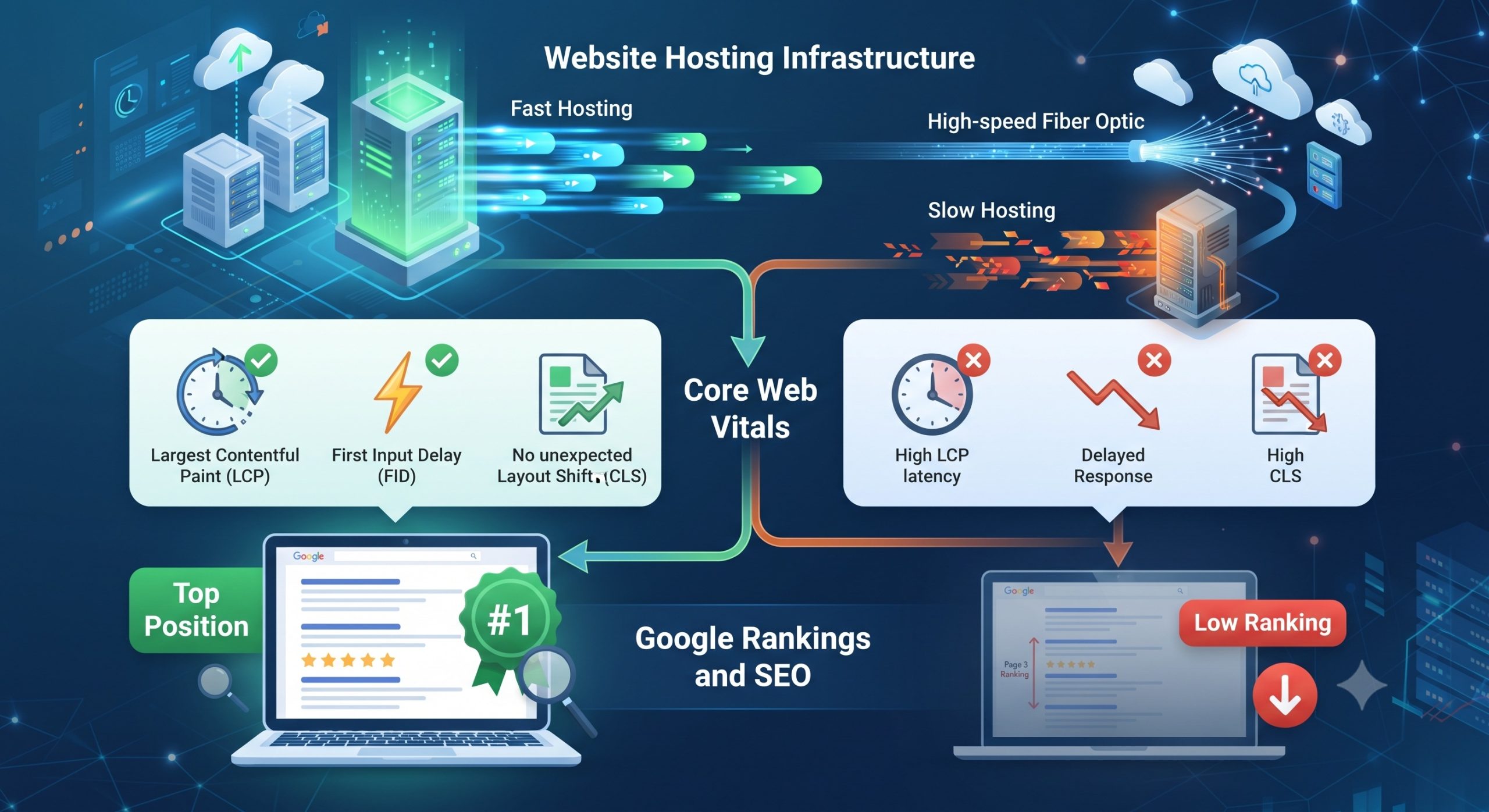
Core Web Vitals are Google’s metrics for evaluating important aspects of real-world user experience. The current Core Web Vitals include Largest Contentful Paint (LCP), Interaction to Next Paint (INP), and Cumulative Layout Shift (CLS). Google has clarified that INP is now a Core Web Vital, replacing FID.

Largest Contentful Paint (LCP)

LCP measures loading performance by looking at how quickly the largest visible content element becomes rendered. This could be a large image, heading or other major page element.

Hosting can influence the early stages of the loading process because the browser needs to communicate with the server and retrieve resources. A responsive hosting environment can therefore contribute to a better loading experience, although factors such as image optimization, caching, CSS, JavaScript and page structure also play major roles.

Interaction to Next Paint (INP)

INP measures how responsive a webpage is when users interact with it. Clicking buttons, opening menus, selecting filters and interacting with forms can all involve browser-side processing.

Hosting does not directly control all aspects of INP because much of the metric depends on JavaScript execution in the browser. However, hosting contributes to the overall infrastructure delivering the website’s scripts and resources. Developers should therefore combine suitable hosting with efficient JavaScript and frontend optimization.

Cumulative Layout Shift (CLS)

CLS measures visual stability. A page has a poor experience when content unexpectedly moves while users are reading or interacting with it.

Hosting alone cannot solve every CLS problem. Layout shifts are commonly caused by images without defined dimensions, dynamically injected content, advertisements, fonts and other frontend elements. Nevertheless, reliable infrastructure helps ensure resources are delivered consistently while proper website development addresses the layout itself.

Does Better Hosting Directly Improve Google Rankings?

One of the most important questions businesses ask is whether upgrading their hosting will automatically increase their Google rankings.

The answer is no.

Better hosting does not guarantee higher rankings. Google evaluates many aspects of a website, and page experience is only one component of overall Search. A website can have excellent server performance but still struggle to rank if its content does not satisfy search intent, its pages are poorly optimized or its technical SEO has serious problems.

However, reliable hosting can support SEO by helping a website maintain good performance, accessibility and user experience. Think of hosting as part of the technical foundation rather than a ranking shortcut.

A useful SEO strategy combines high-quality content, search intent optimization, technical SEO, mobile usability, internal linking, structured data where appropriate, website security and strong performance.

The Connection Between Server Response Time and Website Performance

Before a webpage can display its content, the browser needs to communicate with the website’s server. The server then processes the request and begins delivering the necessary resources.

If the server is under heavy load or does not have sufficient resources, the initial response can take longer. This can contribute to slower page loading and create additional performance challenges.

For small websites with modest traffic, basic web hosting may be sufficient. As traffic, databases, applications or resource requirements grow, businesses may need more capable infrastructure.

Cloud VPS hosting can provide a more scalable environment for growing websites, while dedicated servers can provide significantly greater control and resources for demanding workloads. Parallax Hosting currently offers cloud VPS solutions with full root access and dedicated server solutions designed for resource-intensive applications.

How Hosting Resources Influence Website Performance

Different websites require different levels of infrastructure. A simple business website with a few pages has very different requirements from an online store containing thousands of products, a membership platform or a high-traffic web application.

CPU and RAM

CPU resources help process website requests, applications and database operations, while RAM allows systems to handle active processes efficiently. When a website consistently exceeds available resources, performance can suffer.

Storage Technology

Storage also matters. Faster storage can improve the speed at which website files and databases are accessed. Parallax Hosting’s dedicated server offerings include NVMe SSD storage on selected configurations, along with high-speed network connectivity and dedicated resources.

Network Connectivity

Even a well-optimized server needs reliable connectivity to deliver content efficiently. Network performance can influence how quickly resources travel between the server and visitors.

Scalability

A website may perform well during normal traffic but struggle during a marketing campaign, seasonal sale or viral traffic spike. Scalable infrastructure can help businesses prepare for changing workloads.

This is particularly important for e-commerce businesses, SaaS platforms and websites running advertising campaigns where sudden traffic increases can occur.

How Uptime Can Support SEO

Website availability is another important reason to take hosting seriously.

If your website repeatedly becomes unavailable, visitors cannot access your content, products or services. Extended technical problems can also interfere with crawling and create a poor experience for users.

Reliable hosting therefore helps maintain a consistent online presence. Businesses should look beyond a simple uptime percentage and consider the hosting provider’s infrastructure, monitoring, support, backup strategy and ability to respond when problems occur.

Parallax Hosting advertises a 99.9% uptime guarantee on its hosting offerings and provides 24/7 customer support.

Website Security and Its Relationship With SEO

Security is another important component of a healthy website.

An SSL certificate enables HTTPS encryption between a website and its visitors. HTTPS protects information transmitted between the browser and server and provides visitors with a secure connection.

Google treats HTTPS as a lightweight ranking signal, but security should not be viewed simply as an SEO tactic. HTTPS is important for protecting users, building trust and maintaining a professional online presence.

Parallax Hosting offers SSL certificates with options including DV, OV, EV and Wildcard SSL. Its SSL services provide HTTPS encryption and are designed to protect websites and their users.

Businesses should also make sure that their entire website consistently uses HTTPS and that HTTP versions redirect correctly to the secure version. Google provides specific guidance for HTTPS migrations and website infrastructure changes.

Why Hosting Matters More for E-Commerce Websites

E-commerce websites are particularly dependent on reliable hosting because they often combine product databases, high-resolution images, payment systems, customer accounts, search functions, filters, analytics and third-party integrations.

A slow product page can frustrate customers. A delayed checkout can cause abandoned purchases. A server that cannot handle a traffic spike during a sale can potentially result in lost revenue.

For this reason, e-commerce businesses should evaluate hosting based on actual workload rather than choosing a plan only because it has the lowest price.

Businesses should consider available resources, storage, database requirements, scalability, security, backups, technical support and expected traffic before selecting a hosting solution.

Shared Hosting vs VPS Hosting vs Dedicated Servers for SEO

The right hosting solution depends on the website rather than SEO alone.

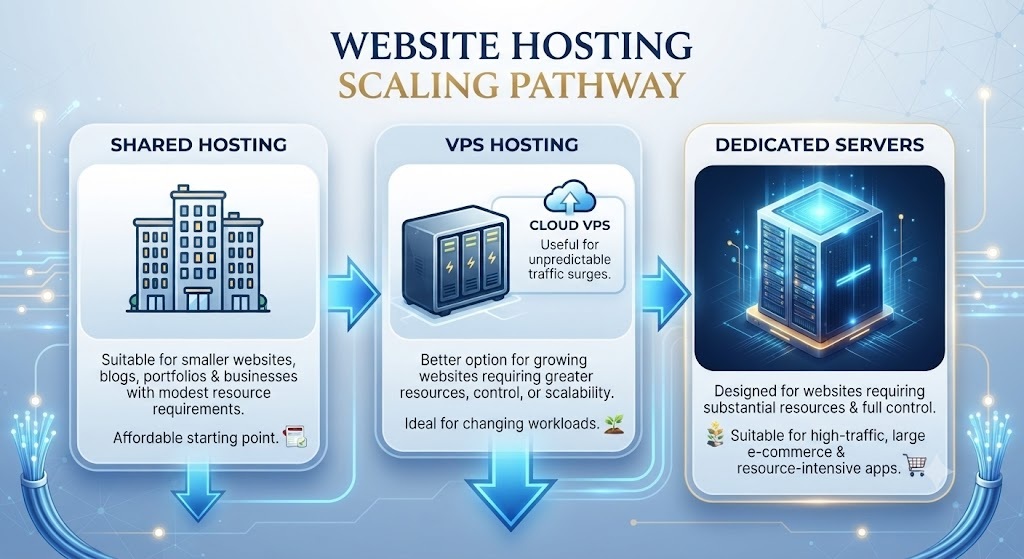
how businesses can scale their website hosting as traffic and resource needs grow—from Shared Hosting to VPS Hosting and finally Dedicated Servers.

Parallax Hosting offers all three types of infrastructure through its web hosting, cloud VPS and dedicated server services, giving businesses multiple options as their requirements evolve.

How to Optimize Hosting for Better SEO Performance

Choosing a quality hosting provider is only the beginning. Businesses should also optimize the website itself.

Start by monitoring Core Web Vitals using tools such as Google Search Console and PageSpeed Insights. Identify pages with slow loading times, poor responsiveness or layout instability and investigate the underlying causes.

Compress large images and use modern image formats where appropriate. Remove unnecessary plugins and scripts that increase page weight or processing requirements. Implement caching where suitable and optimize databases for websites that depend heavily on dynamic content.

A Content Delivery Network can also help distribute static resources closer to users in different geographic locations. For businesses serving audiences across multiple regions, CDN configuration can complement a well-optimized hosting environment.

Website owners should also keep their CMS, plugins, themes, frameworks and server software updated. Outdated software can create security and performance issues.

How to Choose the Right Hosting Provider for SEO

When selecting web hosting, do not judge providers solely by price. Consider the complete infrastructure and support ecosystem.

Look for reliable uptime, suitable CPU and RAM resources, fast storage, strong network connectivity, scalable hosting options, security features, backups, monitoring and responsive technical support.

You should also evaluate whether the provider offers a hosting plan that can grow with your website. A business may begin with standard web hosting and eventually require VPS or dedicated infrastructure as traffic and application complexity increase.

Parallax Hosting provides web hosting, reseller hosting, cloud VPS and dedicated servers, along with SSL and support services, allowing businesses to select infrastructure based on their specific requirements.

Common Hosting Mistakes That Can Hurt Website Performance

One of the most common mistakes is choosing hosting exclusively based on the lowest price. While affordable hosting can be useful for small websites, insufficient resources can become a problem as traffic and functionality increase.

Another mistake is ignoring server resources. Website owners should monitor CPU, RAM, storage and bandwidth usage rather than waiting until visitors report that the website is slow.

Using outdated software is another common problem. CMS platforms, plugins and server components should be maintained regularly.

Businesses should also avoid assuming that hosting alone will fix every performance issue. A slow website can be caused by oversized images, inefficient code, excessive JavaScript, poor database queries, third-party scripts or inadequate caching.

The best results come from combining quality hosting with technical SEO and website optimization.

Hosting, SEO and User Experience Work Together

Modern SEO is not simply about adding keywords to webpages. Search engines aim to provide users with useful and relevant results, while businesses need websites that turn visitors into customers.

This makes user experience increasingly important.

Imagine two websites offering similar services. One loads quickly, works smoothly on mobile devices and provides secure navigation. The other takes several seconds to respond, contains layout shifts and occasionally becomes unavailable.

Even if both websites publish good content, the first website provides a stronger overall digital experience.

Hosting cannot replace good content or SEO strategy, but it can provide the infrastructure required to deliver that strategy effectively.

A Practical SEO Hosting Checklist

Before choosing or upgrading hosting, businesses should evaluate:

  • Website traffic and expected future growth
  • CPU and RAM requirements
  • Storage type and capacity
  • Server response performance
  • Network connectivity
  • Uptime and reliability
  • SSL and HTTPS support
  • Backup options
  • Security features
  • Scalability
  • Technical support
  • Server location and target audience
  • Caching and CDN compatibility
  • Database requirements
  • CMS and application requirements

Review these factors regularly because hosting requirements can change as a website grows.

Final Thoughts

Website hosting and SEO are more closely connected than many businesses realize. Hosting does not directly guarantee better Google rankings, but it can influence the technical environment in which a website operates.

Reliable hosting can support faster server responses, consistent availability, secure HTTPS connections and a better overall user experience. These factors work alongside content quality, technical SEO, mobile optimization and other ranking considerations.

Core Web Vitals make website experience even more important. LCP, INP and CLS provide useful ways to evaluate how real users experience a website, but businesses should remember that improving these metrics requires more than simply changing hosting providers.

For smaller websites, a well-configured web hosting plan may be enough. Growing websites may benefit from cloud VPS infrastructure, while demanding applications and high-traffic businesses may require dedicated servers.

The key is to choose hosting based on your website’s actual requirements and combine reliable infrastructure with strong SEO, high-quality content, technical optimization and continuous performance monitoring.

If your business website is growing, investing in the right hosting infrastructure can be an important step toward creating a faster, more reliable and secure digital experience.

Explore Parallax Hosting‘s web hosting, Cloud VPS and dedicated server solutions to find infrastructure suited to your website’s performance and growth requirements.

Namrata J.
The Author

Namrata J.

Related posts

07 September
Technology Market Growth in 2026: How AI, Cloud Computing & High-Performance Hosting Are Driving Business Growth

The technology industry is entering another major phase of expansion in 2026. Artificial intelligence, cloud computing, cybersecurity, automation, high-performance infrastructure, and digital transformation are changing how businesses operate, compete, and serve customers. According to Gartner, […]

Read more
185 comment 0 By Namrata J.
26 August
How Website Hosting Affects Google Rankings, Core Web Vitals & SEO

Introduction When businesses invest in SEO, they usually focus on keywords, content, backlinks, technical optimization and social media promotion. However, one important part of website performance is often overlooked: web hosting. The hosting environment behind […]

Read more
162 comment 0 By Namrata J.
24 July
Manage Your Business from Anywhere This Summer

Summer is the perfect time to enjoy a change of scenery, take a well-earned vacation, or simply work from your favorite destination. Thanks to modern cloud technology, running a business is no longer tied to […]

Read more
258 comment 0 By Namrata J.
eCommerce August 13, 2026 Namrata J. 273

How AI-powered, fast, secure hosting transforms online shopping

How AI-powered, fast, secure hosting transforms online shopping

Introduction

Online shopping is entering a new era in 2026. It is no longer simply about putting products on a website and waiting for customers to find them. Artificial intelligence is changing how shoppers discover products. Website performance influences how customers interact with online stores, and security remains essential to trust. This shift makes ecommerce strategies more important for long-term success.

Today’s shoppers can discover a product through Google, social media, a creator’s video, or an AI shopping assistant. They can compare products within seconds, read reviews, check prices, ask questions, and complete ecommerce purchases from a smartphone.

This transformation creates a new challenge for e-commerce businesses: the online store must be fast, secure, reliable, and technically prepared for an increasingly AI-driven shopping journey.

For businesses, this means hosting is becoming more than a place to keep website files. A reliable hosting environment can provide the infrastructure required to support fast page delivery, secure transactions, traffic spikes, databases, APIs, AI integrations, and growing customer demand.

In this article, we explore how AI, website speed, and secure hosting are changing online shopping in 2026, and why e-commerce businesses should consider performance and infrastructure as part of their long-term growth strategy.

The E-commerce Shopping Journey Is Changing

For many years, online shopping followed a relatively predictable journey.

A customer searched for a product, visited a search engine, clicked a website, compared products, added an item to a cart, and completed a purchase.

That journey is becoming more complicated.

In 2026, a shopper may discover a product while watching a short video, ask an AI assistant for recommendations, compare products through a conversational interface, visit a retailer’s website to verify product information, and then complete the purchase directly on the merchant’s website.

Meta reported in May 2026 that India’s e-commerce journey is shifting from traditional search-and-transact behavior toward a discovery ecosystem influenced by AI, Reels, creators, and conversational messaging.

This means e-commerce businesses need to think beyond traditional SEO.

They need to create websites that work well for people, search engines, social platforms, and emerging AI-driven discovery systems.

How Artificial Intelligence Is Changing Online Shopping

Artificial intelligence is rapidly becoming part of the shopping experience.

AI can help customers discover products, compare alternatives, summarize information, answer questions, personalize recommendations, and navigate large product catalogs.

Instead of searching for a broad keyword such as “best laptop under ₹70,000,” a customer can ask an AI shopping assistant something much more specific:

“I need a lightweight laptop for business travel, with long battery life, at least 16GB RAM, and a budget below ₹70,000. Which options should I consider?”

The interaction becomes conversational rather than keyword-based.

This changes the way businesses need to present product information.

Product titles, specifications, descriptions, availability, pricing, reviews, FAQs, policies, and structured data all become increasingly important because both customers and automated systems need clear information to understand what a product offers.

Recent reporting also shows that retailers are actively adapting to traffic from AI shopping tools such as ChatGPT and Google’s Gemini. Reuters reported in August 2026 that retailers are working to appear in AI-driven shopping results while encouraging customers to complete transactions on their own websites.

For e-commerce businesses, this represents a significant opportunity.

AI can become another discovery channel that sends highly relevant shoppers to an online store.

But there is an important requirement:

The website needs to be ready when that traffic arrives.

AI Traffic Makes Website Performance More Important

Imagine an AI assistant recommends a product from your online store.

The customer clicks the recommendation and lands on your product page.

If the page loads quickly, product information is clear, images appear correctly, and the checkout experience is smooth, the customer can continue naturally through the purchase journey.

But if the website takes too long to respond, the opportunity can disappear.

This is why AI-driven discovery does not eliminate the importance of traditional website performance.

In fact, it can make performance even more important.

AI may help bring a highly relevant customer to your website, but the website still has to convert that visitor.

A growing number of e-commerce businesses therefore need to think about the complete journey:

AI Discovery → Website Visit → Product Page → Cart → Checkout → Purchase

Each stage needs to work efficiently.

Why Website Speed Matters More Than Ever

Website speed is one of the most visible aspects of the ecommerce shopping experience.

Customers do not want to wait for product images to load, search results to appear, filters to respond, or checkout pages to process.

When a website is slow, customers experience friction.

A visitor might leave before viewing a product.

Another might abandon a shopping cart.

Someone else might decide to purchase from a competitor.

This is particularly important for mobile shoppers.

Mobile users may be browsing on different networks and devices, so e-commerce businesses should avoid unnecessary page weight and technical complexity.

Fast hosting cannot solve every performance problem, but it can provide an important foundation.

A website’s performance depends on many factors, including:

  • Server response time
  • CPU and RAM resources
  • Storage technology
  • Database performance
  • Website code
  • Images
  • JavaScript
  • CSS
  • Plugins
  • APIs
  • Caching
  • CDN configuration
  • Third-party scripts
  • Mobile optimization

The strongest results come when these components are optimized together.

Core Web Vitals and E-commerce Performance

Google’s Core Web Vitals focus on important aspects of real-world user experience.

They currently include:

Largest Contentful Paint (LCP): Measures loading performance.

Interaction to Next Paint (INP): Measures how responsive a page is to user interactions.

Cumulative Layout Shift (CLS): Measures visual stability.

For an e-commerce website, these metrics matter because customers interact with pages continuously.

They open menus, select product variants, apply filters, use search, click buttons, view images, read reviews, and add products to carts.

If the website responds slowly or elements unexpectedly move around, the shopping experience becomes frustrating.

Google emphasizes that page experience is only one part of Search and that businesses should continue focusing on helpful, relevant content and overall website quality.

Therefore, e-commerce businesses should not try to improve rankings by focusing on speed alone.

Instead, they should build websites that combine:

Helpful content + strong technical SEO + good performance + mobile usability + secure infrastructure + excellent customer experience.

How Hosting Influences Website Performance

Hosting provides the infrastructure that processes website requests and delivers content to visitors.

When someone opens an e-commerce product page, the request may involve the web server, database, application, images, APIs, caching systems, and other services.

If the hosting environment is underpowered or overloaded, the website may struggle to respond efficiently.

High-performance hosting can provide resources designed to handle demanding workloads.

Depending on the hosting solution, this may include:

  • High-speed NVMe SSD storage
  • Dedicated or allocated CPU resources
  • Sufficient RAM
  • Optimized server configurations
  • Reliable networking
  • Scalable infrastructure
  • Backup systems
  • Security tools
  • Monitoring
  • Technical support

For a growing e-commerce business, the hosting environment should be selected according to the actual workload rather than simply choosing the cheapest available plan.

Why NVMe SSD Hosting Can Benefit Online Stores

E-commerce websites rely heavily on databases.

Product catalogs, customer accounts, orders, inventory, reviews, and other information may be stored in databases.

Fast storage can help support workloads that frequently access this data.

NVMe SSD technology provides high-speed storage and can be particularly useful for database-driven applications.

For example, when a customer searches for a product, the website may need to process database queries and return relevant information.

When the customer places an order, the system may need to update inventory and create order information.

When a customer logs into an account, the website may retrieve account and order data.

Fast storage is only one part of performance, but it can contribute to an efficient hosting environment when combined with adequate CPU, RAM, optimized databases, caching, and well-developed software.

Why Secure Hosting Is Essential for E-commerce

Speed attracts visitors.

Security helps retain their trust.

E-commerce websites can handle sensitive information and are attractive targets for cybercriminals.

Online stores may face threats such as:

  • DDoS attacks
  • Credential stuffing
  • Malicious bots
  • Account takeover attempts
  • Malware
  • Vulnerable plugins
  • Automated scraping
  • Inventory abuse
  • Payment-related fraud
  • Supply-chain script attacks

Cloudflare’s 2026 e-commerce guidance identifies DDoS attacks, credential stuffing, payment fraud, supply-chain script injection, and bot activity as important security concerns for online stores.

This means e-commerce security cannot be treated as a one-time installation.

It needs continuous attention.

A strong security strategy can include SSL/TLS encryption, firewalls, secure authentication, malware monitoring, backups, access controls, software updates, application security, and appropriate DDoS and bot protection.

The Growing Threat of Automated Bots

Bots are becoming a particularly important issue for e-commerce businesses.

Not all bots are bad.

Search engines use crawlers to discover and index websites. Other legitimate services may also interact with online stores.

The problem occurs when malicious automation consumes resources or attempts to abuse the website.

Bots can be used for:

  • Credential stuffing
  • Content scraping
  • Inventory hoarding
  • Account attacks
  • Price monitoring
  • Automated abuse
  • Server-resource consumption

Cloudflare’s current documentation notes that malicious bots can scrape content, use stolen credentials, hoard inventory, and increase server costs.

Cloudflare also reported in July 2026 that automated bot activity had reached roughly 57% of web requests across its network, illustrating how significant automated traffic has become.

For e-commerce businesses, this creates an important infrastructure challenge.

The goal is not simply to block everything automated.

Businesses need to distinguish between useful traffic and malicious automation.

AI Agents Create a New Type of Web Traffic

The development of AI shopping agents introduces another important consideration.

AI systems can increasingly search for products, compare options, evaluate information, and potentially assist users with purchasing tasks.

This means websites may increasingly interact with automated systems that behave differently from traditional search-engine crawlers.

A website that provides clear product information, structured data, consistent pricing information, inventory details, and accessible navigation is easier for both people and machines to understand.

However, businesses also need to consider security and authorization.

As AI agents become more capable of performing actions, businesses need mechanisms to distinguish legitimate automated activity from malicious bots.

Cloudflare has highlighted the emerging security requirements around AI agents and agent commerce, including the need to distinguish legitimate agents from malicious automated traffic.

This is another reason why e-commerce infrastructure needs to evolve alongside the shopping experience.

Website Security Builds Customer Trust

Customers want to know that the website they are using is legitimate and secure.

A secure website should use HTTPS and properly configured SSL/TLS.

But trust extends beyond the padlock icon.

Customers also look for:

  • Clear return policies
  • Transparent pricing
  • Secure checkout
  • Recognizable payment methods
  • Accurate product information
  • Reliable customer support
  • Consistent branding
  • Privacy information
  • Professional website design

Technical security and customer trust therefore work together.

An e-commerce website that looks professional but experiences security incidents can quickly lose customer confidence.

A secure infrastructure strategy helps businesses protect both their technical systems and their reputation.

Why HTTPS and SSL Matter

SSL/TLS encryption protects data exchanged between a customer’s browser and the website.

For an e-commerce store, this is especially important because customers may submit login information, contact details, and other sensitive information.

HTTPS should therefore be a basic requirement for modern online stores.

However, businesses should understand that an SSL certificate is only one layer of security.

A complete security strategy should also include:

Secure hosting + HTTPS + strong passwords + software updates + backups + monitoring + application security + access controls.

Security needs to be approached as a system rather than a single feature.

High-Performance Hosting Helps Handle Traffic Spikes

E-commerce traffic can change rapidly.

A business may receive normal traffic for weeks and then experience a dramatic increase during a major sale.

Traffic spikes can happen because of:

  • Festival promotions
  • Diwali campaigns
  • Black Friday
  • New product launches
  • Influencer campaigns
  • Viral social media content
  • Google Ads
  • Instagram Ads
  • Email campaigns
  • Flash sales

If the hosting environment cannot handle the increased load, pages may become slow or unavailable.

Modern e-commerce infrastructure can use technologies such as caching, load balancing, CDNs, and scalable hosting to help handle periods of increased demand. Cloudflare’s current e-commerce architecture guidance specifically highlights caching, image optimization, load balancing, and traffic-spike handling.

Businesses should therefore evaluate hosting based on both normal traffic and peak traffic.

VPS Hosting for Growing Online Stores

Shared hosting can be an affordable starting point for small websites.

But as an e-commerce store grows, it may require more resources and control.

VPS hosting can provide a more controlled environment for growing online stores.

A VPS can be useful for:

  • Growing WooCommerce stores
  • Medium-sized e-commerce websites
  • Custom applications
  • Higher traffic websites
  • Businesses requiring custom server configurations
  • Developers who need greater control

The right VPS configuration depends on traffic, CPU requirements, RAM requirements, database size, storage requirements, and software architecture.

Businesses should avoid choosing a VPS solely because it has a larger number of resources.

The objective is to choose resources that match actual business needs.

When a Dedicated Server Makes Sense

Large e-commerce websites may eventually require dedicated infrastructure.

Dedicated servers provide physical server resources for a specific customer and can provide greater control and customization.

They may be suitable for:

  • Large online stores
  • High-traffic marketplaces
  • Resource-intensive applications
  • Large databases
  • Complex e-commerce systems
  • Businesses with specialized infrastructure requirements

However, dedicated hosting is not automatically better for every business.

A well-optimized VPS or cloud environment may be perfectly suitable for many growing businesses.

The correct solution depends on the website’s workload and future growth requirements.

AI and Personalization Are Increasing Server Workloads

AI-powered personalization can make shopping more relevant.

An e-commerce website can use customer behavior, product data, browsing patterns, and purchase history to recommend products.

For example, a customer who is browsing running shoes might receive recommendations for sports socks, fitness watches, or running accessories.

Personalization can create a more engaging shopping experience.

However, these features also introduce additional technical workloads.

The website may need to process:

  • Customer behavior
  • Product information
  • Recommendation data
  • API requests
  • Search queries
  • Analytics
  • Personalization rules

This makes efficient infrastructure increasingly important.

Businesses should monitor their server resources and application performance as they add AI-powered features.

Website Speed and Conversion Optimization

The purpose of e-commerce SEO is not simply to bring visitors.

The ultimate goal is to generate meaningful business results.

A customer may discover a product through Google or an AI assistant, but the purchase happens on the website.

This creates a simple but important equation:

More qualified visitors + better experience = more opportunities for conversions.

Website speed influences the experience.

Consider this customer journey:

AI Recommendation → Product Page → Add to Cart → Checkout → Payment

If every stage works smoothly, the customer has fewer reasons to leave.

If the website becomes slow or unreliable at any stage, conversion opportunities can disappear.

This is why performance should be considered part of conversion-rate optimization.

Why Mobile Performance Matters in 2026

Mobile shopping continues to influence e-commerce.

Customers may discover products through Instagram Reels, YouTube Shorts, WhatsApp, search results, advertisements, and creator content.

Many of these experiences begin on mobile devices.

A mobile visitor expects:

  • Fast page loading
  • Easy navigation
  • Readable content
  • Large touch-friendly buttons
  • Fast search
  • Optimized images
  • Simple checkout
  • Secure payment

A website that performs well on desktop but poorly on mobile can lose a significant number of potential customers.

Businesses should therefore test website performance across different devices and network conditions.

AI Discovery Is Changing SEO

Traditional SEO focuses heavily on helping search engines understand website content.

The rise of AI-driven discovery adds another layer.

Businesses increasingly need to make their content clear and useful enough for both humans and machine-driven discovery systems.

This means product pages should provide detailed and accurate information.

Instead of writing:

“Premium shoes available online.”

A stronger product description might explain:

  • Product type
  • Materials
  • Size options
  • Available colors
  • Intended use
  • Key features
  • Compatibility
  • Care instructions
  • Shipping information
  • Warranty
  • Return policy

Clear information helps customers make decisions and gives automated systems more context.

However, businesses should avoid creating artificial content solely for AI systems.

The priority should remain accurate, useful, original content for customers.

How to Prepare an E-commerce Website for AI-Driven Shopping

Businesses preparing for AI-driven commerce should focus on their fundamentals.

Create Clear Product Information

Use accurate product titles, descriptions, specifications, prices, availability, and policies.

Use Structured Data

Where appropriate, implement relevant structured data to help search engines understand product information.

Maintain Accurate Inventory

Incorrect availability can create poor customer experiences and undermine automated recommendations.

Improve Website Accessibility

Make navigation and important information easy for both people and automated systems to understand.

Build Fast Product Pages

AI-driven traffic still ends up interacting with your website.

Protect Automated Access

Distinguish legitimate crawlers and agents from malicious automation.

Monitor Traffic

Understand where visitors and automated requests are coming from.

Why Scalable Hosting Is Important for Growing E-commerce Businesses

A website may start with a few hundred visitors and eventually receive hundreds of thousands.

A hosting strategy that works today may not work next year.

Scalability allows businesses to increase resources as requirements change.

This is especially important for:

  • Startups
  • Fast-growing stores
  • Seasonal businesses
  • Product launches
  • Online marketplaces
  • Businesses expanding internationally

Scalable hosting can help businesses prepare for growth without constantly rebuilding their infrastructure.

What Should E-commerce Businesses Look for in Hosting?

When selecting hosting in 2026, businesses should consider more than price.

1. Performance

Look for sufficient CPU, RAM, high-speed storage, and optimized infrastructure.

2. Reliability

Evaluate uptime practices, monitoring, backups, and infrastructure redundancy.

3. Security

Look for SSL/TLS, firewall options, malware protection, backups, monitoring, and appropriate DDoS protection.

4. Scalability

Make sure resources can be increased when traffic grows.

5. Support

Technical support can be critical when an online store is experiencing performance or security issues.

6. Backup and Recovery

A reliable backup strategy helps businesses recover from unexpected problems.

7. Technology Compatibility

Make sure the hosting environment supports your e-commerce platform, database, plugins, APIs, and applications.

8. Storage Technology

NVMe SSD storage can be valuable for database-driven and resource-intensive websites.

How Parallax Hosting Can Support Modern E-commerce

For an online business, hosting should be viewed as part of the overall digital infrastructure.

Parallax Hosting provides hosting solutions for businesses and websites with different infrastructure and performance requirements.

Depending on your website’s size and workload, solutions such as NVMe SSD hosting, VPS hosting, dedicated servers, SSL security, reliable infrastructure, backups, and technical support can help create a stronger foundation for online operations.

The right hosting solution depends on your e-commerce platform, traffic levels, product catalog, database requirements, security needs, and growth plans.

Instead of waiting until your website experiences serious performance problems, businesses should evaluate their infrastructure before major campaigns, seasonal sales, or product launches.

How to Improve E-commerce Website Performance

Hosting is important, but it is only one part of website performance.

Businesses should also optimize the website itself.

Optimize Product Images

Large images can increase page size and slow down loading. Compress product images and use modern formats where appropriate.

Reduce Unnecessary Plugins

Too many plugins can increase processing requirements and create security risks. Remove plugins that are no longer required.

Optimize Your Database

Regularly review database performance, queries, and unnecessary data.

Use Caching

Caching can reduce repeated processing and improve response times for appropriate content.

Use a CDN

A CDN can help distribute static content closer to users, especially when an online store serves customers across different locations.

Minimize Unnecessary Scripts

Third-party tracking, advertising, chat tools, and other scripts can increase page complexity.

Only use tools that provide genuine business value.

Monitor Core Web Vitals

Use tools such as Google Search Console and PageSpeed Insights to identify performance problems.

Security and Performance Must Work Together

Businesses sometimes treat performance and security as separate topics.

In reality, they are connected.

A security system that is poorly configured can create unnecessary friction.

A performance optimization that ignores security can expose the website to risk.

The goal should be to create an infrastructure strategy where:

Security protects the website without unnecessarily slowing legitimate customers.

Modern e-commerce security can include layered application protection, SSL/TLS encryption, bot management, DDoS mitigation, monitoring, and secure server configurations. Cloudflare’s current e-commerce documentation describes this layered approach as a way to protect stores while minimizing friction for legitimate shoppers.

The Future of Online Shopping Is AI-Powered but Trust-Driven

AI can make shopping faster and more personalized, but technology alone cannot create customer trust.

Customers still want:

  • Accurate information
  • Secure payments
  • Reliable delivery
  • Transparent policies
  • Easy returns
  • Responsive support
  • Authentic reviews
  • A trustworthy brand

This is particularly important as AI-generated recommendations become more common.

Recent research and industry reporting indicate that consumers can find AI recommendations useful while still having concerns about trust, privacy, and how recommendations are generated.

For businesses, the message is clear:

Use AI to improve the customer experience, but do not sacrifice transparency, security, or control.

The E-commerce Infrastructure Checklist for 2026

Before scaling an online store, businesses should ask:

Is the website fast?

Can it handle sudden traffic spikes?

Is the server properly secured?

Are customer connections encrypted with HTTPS?

Are backups available?

Is the database optimized?

Are product pages mobile-friendly?

Are Core Web Vitals being monitored?

Can the infrastructure scale as traffic grows?

Can legitimate search crawlers and AI-related traffic access the site appropriately?

Are malicious bots and abusive traffic being monitored?

Is the hosting provider able to provide timely technical support?

If several answers are “no” or “not sure,” it may be time to review the website’s infrastructure.

Conclusion

Online shopping in 2026 is becoming smarter, faster, more personalized, and more complex.

Artificial intelligence is changing how customers discover products.

Website speed is shaping how customers interact with online stores.

Mobile commerce is making performance more important.

Cybersecurity threats are becoming more sophisticated.

Automated traffic and AI agents are introducing new infrastructure considerations.

Together, these trends are changing what businesses need from their websites.

An e-commerce website is no longer simply a digital catalog.

It is a technology platform that needs to support discovery, personalization, product search, customer accounts, databases, payments, analytics, security, and increasingly sophisticated interactions.

That is why high-performance and secure hosting has become an important part of modern e-commerce strategy.

The strongest approach is not to focus on hosting alone.

Businesses should combine:

High-performance hosting + fast website design + secure infrastructure + mobile optimization + technical SEO + quality content + scalable technology + continuous monitoring.

When these elements work together, an online store is better prepared to attract visitors, deliver a smoother shopping experience, protect customer trust, and support long-term growth.

The question for e-commerce businesses in 2026 is no longer simply:

“Is my online store live?”

The better question is:

“Is my online store fast, secure, scalable, and ready for the future of AI-powered shopping?”

For businesses that want to compete in the next phase of e-commerce, investing in the right infrastructure today can create a stronger foundation for tomorrow.

Frequently Asked Questions

How is AI changing online shopping in 2026?

AI is changing product discovery, recommendations, search, customer support, personalization, and shopping assistance. Customers can increasingly use conversational AI to discover and compare products instead of relying exclusively on traditional search.

Why is website speed important for e-commerce?

Website speed affects how quickly customers can browse products, interact with pages, add items to carts, and complete purchases. Slow pages can create friction and negatively affect the overall shopping experience.

Does hosting affect website speed?

Hosting can affect server response and resource availability, but it is not the only factor. Website code, images, databases, caching, plugins, APIs, and CDN configuration also influence performance.

What is secure e-commerce hosting?

Secure e-commerce hosting is an infrastructure environment designed to support website security through technologies and practices such as HTTPS, SSL/TLS, firewalls, backups, monitoring, malware protection, access controls, and appropriate DDoS and bot protection.

Is VPS hosting good for e-commerce websites?

VPS hosting can be a suitable choice for growing online stores that require more resources and control than basic shared hosting provides. The correct configuration depends on the store’s traffic and technical workload.

Why is NVMe hosting useful for e-commerce?

NVMe SSD storage provides high-speed data access and can be useful for database-driven websites such as online stores. Overall performance still depends on CPU, RAM, database optimization, caching, application architecture, and other factors.

Can AI traffic affect website performance?

Yes. AI-related crawlers, services, integrations, and shopping agents can generate additional requests. Businesses should monitor automated traffic and distinguish legitimate activity from malicious bots.

How can I make my e-commerce website faster?

Start by measuring performance. Optimize product images, reduce unnecessary scripts and plugins, improve database performance, use caching, consider a CDN, optimize your hosting environment, and monitor Core Web Vitals.

Does fast hosting guarantee better Google rankings?

No. Fast hosting does not guarantee higher rankings. Google considers many factors, including relevance, content quality, technical accessibility, and overall page experience. Performance should be treated as one part of a broader SEO strategy.

Namrata J.
The Author

Namrata J.

Related posts

13 August
How AI-powered, fast, secure hosting transforms online shopping

Introduction Online shopping is entering a new era in 2026. It is no longer simply about putting products on a website and waiting for customers to find them. Artificial intelligence is changing how shoppers discover […]

Read more
273 comment 0 By Namrata J.
19 February
Enhancing E-Commerce Security with SSL Certificates

In today’s digital marketplace, e-commerce security is the foundation of online business success. Customers share sensitive information such as personal details, login credentials, and payment data when shopping online. A single security breach can damage […]

Read more
307 comment 0 By Namrata J.
12 July
12 Link Building Ideas for eCommerce Sites

Link building is hard. That statement is simple, but the truth behind it is complicated. You know you need to get links from other websites – high-authority, relevant websites, no less – for your website […]

Read more
1632 comment 0 By Udit Nag
Technology July 24, 2026 Namrata J. 258

Manage Your Business from Anywhere This Summer

Manage Your Business from Anywhere This Summer

Summer is the perfect time to enjoy a change of scenery, take a well-earned vacation, or simply work from your favorite destination. Thanks to modern cloud technology, running a business is no longer tied to a physical office. Whether you’re relaxing on a beach, visiting family, or exploring a new city, you can continue managing your business efficiently—as long as you have the right digital tools and a reliable web hosting provider. With Parallax Hosting, your website, email, and online services remain accessible, secure, and fast wherever your summer takes you.

Why Running a Business Remotely Is Easier Than Ever

Technology has transformed the way businesses operate. Entrepreneurs, freelancers, eCommerce stores, agencies, consultants, and startups can now manage daily operations using cloud-based platforms, mobile apps, and remote collaboration tools. Customer inquiries can be answered instantly, online orders can be processed automatically, and business performance can be monitored from a smartphone or laptop.

Whether you manage a personal blog, an online store, a company website, or client projects, having dependable hosting ensures your digital presence stays available around the clock. This means your business keeps working even while you’re enjoying your summer break.

Your Website Should Never Take a Vacation

Your business may be on holiday, but your website should always remain online. Customers expect websites to load quickly, remain secure, and be available whenever they need information or want to make a purchase.

A slow or unavailable website can lead to lost visitors, reduced search engine rankings, and missed sales opportunities. That’s why choosing a trusted hosting provider is essential. Parallax Hosting offers high-performance hosting solutions designed to keep your website running smoothly 24/7, allowing your customers to access your business anytime from anywhere in the world.

Stay Connected with Professional Business Email

Communication is one of the most important aspects of running a business remotely. Using a professional email address that matches your domain builds trust and keeps your brand looking professional.

Whether you’re responding to clients from your laptop or checking messages on your mobile phone, business email allows you to stay connected no matter where you are. With synchronized email, contacts, and calendars, you can manage appointments, communicate with customers, and never miss important opportunities during your travels.

Cloud Hosting Gives You Freedom

Cloud technology has changed the way businesses operate. Instead of relying on a single physical server, cloud hosting distributes resources across multiple systems, providing better reliability, performance, and uptime.

your business can operate from anywhere during the summer with the power of cloud hosting.

This flexibility means your website can continue serving visitors even during traffic spikes or unexpected hardware issues. Whether your audience is local or global, cloud hosting ensures faster loading speeds and improved reliability, helping your business remain productive throughout the summer season.

Secure Your Business While Working Remotely

Working from hotels, airports, cafés, or public Wi-Fi networks can expose your business to security risks. Cybercriminals often target unsecured connections to steal sensitive information.

Protecting your website with SSL certificates encrypts customer data and builds visitor trust. Strong passwords, two-factor authentication, regular backups, and secure hosting environments further strengthen your online security. With Parallax Hosting’s reliable hosting infrastructure, your website benefits from enhanced security measures that help keep your business protected wherever you work.

Essential Tools for Running Your Business Anywhere

Managing your business remotely becomes much easier when you use the right digital tools. A reliable laptop or smartphone, cloud storage services, video conferencing applications, project management platforms, password managers, and secure backups all help ensure business continuity.

Most importantly, your website should be hosted on a dependable platform that offers excellent uptime, fast performance, automatic backups, and responsive customer support. These features minimize downtime and allow you to focus on growing your business instead of worrying about technical issues.

Boost Productivity During Summer

Summer often brings flexible schedules, making it an ideal time to improve business processes. Automating repetitive tasks such as email responses, backups, customer support tickets, and website monitoring allows you to spend more time focusing on strategy and growth.

Reliable hosting also helps maintain fast website performance, improves user experience, and supports better search engine rankings. Every second saved through improved website speed contributes to higher customer satisfaction and increased conversion rates.

Scale Your Business Without Limits

As your business grows, your hosting should grow with it. Whether you’re launching a new website, expanding an online store, adding business email accounts, or upgrading to VPS or cloud hosting, scalability ensures your infrastructure keeps pace with your success.

Parallax Hosting provides flexible hosting solutions suitable for startups, small businesses, developers, agencies, and growing enterprises. This allows you to upgrade resources whenever your business needs increase without disrupting your website.

Why Choose Parallax Hosting?

Choosing the right hosting provider is one of the most important decisions for any online business. Parallax Hosting combines performance, security, affordability, and expert support to help businesses succeed online.

With Parallax Hosting, you benefit from:

  • Fast and reliable web hosting
  • High uptime for uninterrupted availability
  • Free SSL certificates for enhanced security
  • Professional business email solutions
  • Domain registration services
  • VPS and Cloud Hosting options
  • 24/7 technical support
  • Scalable hosting plans for growing businesses

Whether you’re running a personal website, an eCommerce business, or managing multiple client projects, Parallax Hosting provides the infrastructure you need to stay productive from anywhere.

Final Thoughts

Summer should be about enjoying freedom—not worrying about your website. With the right hosting provider, secure infrastructure, and cloud-based tools, you can confidently manage your business from virtually anywhere while delivering a seamless experience to your customers.

Whether you’re working from a mountain cabin, a beachside café, or your backyard, your business deserves hosting that is fast, secure, and always available.

This summer, let your website work as hard as you do.

Power your online business with Parallax Hosting and stay connected wherever life takes you.

Explore our hosting solutions today: https://parallaxhosting.com/

Namrata J.
The Author

Namrata J.

Related posts

06 October
From Aichi-Nagoya 2026 to the Digital Future: How Cloud Technology Is Powering Global Sports

The Aichi-Nagoya 2026 Asian Games have shown how modern sports are becoming increasingly connected with technology. Held in Japan from September 19 to October 4, 2026, the 20th Asian Games brought athletes and teams from […]

Read more
112 comment 0 By Namrata J.
21 September
.AI Domain Explained: How to Use This Popular Domain Extension in India

The digital world is changing rapidly, and businesses, startups, developers, creators, and technology professionals are looking for domain names that clearly represent their online identity. Among the newer and increasingly popular choices, the .AI domain […]

Read more
173 comment 0 By Namrata J.
07 September
Technology Market Growth in 2026: How AI, Cloud Computing & High-Performance Hosting Are Driving Business Growth

The technology industry is entering another major phase of expansion in 2026. Artificial intelligence, cloud computing, cybersecurity, automation, high-performance infrastructure, and digital transformation are changing how businesses operate, compete, and serve customers. According to Gartner, […]

Read more
185 comment 0 By Namrata J.

Become the part of Parallax Hosting family now!

Get Started