How AI-powered, fast, secure hosting transforms online shopping
Introduction
Online shopping is entering a new era in 2026. It is no longer simply about putting products on a website and waiting for customers to find them. Artificial intelligence is changing how shoppers discover products. Website performance influences how customers interact with online stores, and security remains essential to trust. This shift makes ecommerce strategies more important for long-term success.
Today’s shoppers can discover a product through Google, social media, a creator’s video, or an AI shopping assistant. They can compare products within seconds, read reviews, check prices, ask questions, and complete ecommerce purchases from a smartphone.
This transformation creates a new challenge for e-commerce businesses: the online store must be fast, secure, reliable, and technically prepared for an increasingly AI-driven shopping journey.
For businesses, this means hosting is becoming more than a place to keep website files. A reliable hosting environment can provide the infrastructure required to support fast page delivery, secure transactions, traffic spikes, databases, APIs, AI integrations, and growing customer demand.
In this article, we explore how AI, website speed, and secure hosting are changing online shopping in 2026, and why e-commerce businesses should consider performance and infrastructure as part of their long-term growth strategy.
The E-commerce Shopping Journey Is Changing
For many years, online shopping followed a relatively predictable journey.
A customer searched for a product, visited a search engine, clicked a website, compared products, added an item to a cart, and completed a purchase.
That journey is becoming more complicated.
In 2026, a shopper may discover a product while watching a short video, ask an AI assistant for recommendations, compare products through a conversational interface, visit a retailer’s website to verify product information, and then complete the purchase directly on the merchant’s website.
Meta reported in May 2026 that India’s e-commerce journey is shifting from traditional search-and-transact behavior toward a discovery ecosystem influenced by AI, Reels, creators, and conversational messaging.
This means e-commerce businesses need to think beyond traditional SEO.
They need to create websites that work well for people, search engines, social platforms, and emerging AI-driven discovery systems.
How Artificial Intelligence Is Changing Online Shopping
Artificial intelligence is rapidly becoming part of the shopping experience.
AI can help customers discover products, compare alternatives, summarize information, answer questions, personalize recommendations, and navigate large product catalogs.
Instead of searching for a broad keyword such as “best laptop under ₹70,000,” a customer can ask an AI shopping assistant something much more specific:
“I need a lightweight laptop for business travel, with long battery life, at least 16GB RAM, and a budget below ₹70,000. Which options should I consider?”
The interaction becomes conversational rather than keyword-based.
This changes the way businesses need to present product information.
Product titles, specifications, descriptions, availability, pricing, reviews, FAQs, policies, and structured data all become increasingly important because both customers and automated systems need clear information to understand what a product offers.
Recent reporting also shows that retailers are actively adapting to traffic from AI shopping tools such as ChatGPT and Google’s Gemini. Reuters reported in August 2026 that retailers are working to appear in AI-driven shopping results while encouraging customers to complete transactions on their own websites.
For e-commerce businesses, this represents a significant opportunity.
AI can become another discovery channel that sends highly relevant shoppers to an online store.
But there is an important requirement:
The website needs to be ready when that traffic arrives.
AI Traffic Makes Website Performance More Important
Imagine an AI assistant recommends a product from your online store.
The customer clicks the recommendation and lands on your product page.
If the page loads quickly, product information is clear, images appear correctly, and the checkout experience is smooth, the customer can continue naturally through the purchase journey.
But if the website takes too long to respond, the opportunity can disappear.
This is why AI-driven discovery does not eliminate the importance of traditional website performance.
In fact, it can make performance even more important.
AI may help bring a highly relevant customer to your website, but the website still has to convert that visitor.
A growing number of e-commerce businesses therefore need to think about the complete journey:
AI Discovery → Website Visit → Product Page → Cart → Checkout → Purchase
Each stage needs to work efficiently.
Why Website Speed Matters More Than Ever
Website speed is one of the most visible aspects of the ecommerce shopping experience.
Customers do not want to wait for product images to load, search results to appear, filters to respond, or checkout pages to process.
When a website is slow, customers experience friction.
A visitor might leave before viewing a product.
Another might abandon a shopping cart.
Someone else might decide to purchase from a competitor.
This is particularly important for mobile shoppers.
Mobile users may be browsing on different networks and devices, so e-commerce businesses should avoid unnecessary page weight and technical complexity.
Fast hosting cannot solve every performance problem, but it can provide an important foundation.
A website’s performance depends on many factors, including:
- Server response time
- CPU and RAM resources
- Storage technology
- Database performance
- Website code
- Images
- JavaScript
- CSS
- Plugins
- APIs
- Caching
- CDN configuration
- Third-party scripts
- Mobile optimization
The strongest results come when these components are optimized together.
Core Web Vitals and E-commerce Performance
Google’s Core Web Vitals focus on important aspects of real-world user experience.
They currently include:
Largest Contentful Paint (LCP): Measures loading performance.
Interaction to Next Paint (INP): Measures how responsive a page is to user interactions.
Cumulative Layout Shift (CLS): Measures visual stability.
For an e-commerce website, these metrics matter because customers interact with pages continuously.
They open menus, select product variants, apply filters, use search, click buttons, view images, read reviews, and add products to carts.
If the website responds slowly or elements unexpectedly move around, the shopping experience becomes frustrating.
Google emphasizes that page experience is only one part of Search and that businesses should continue focusing on helpful, relevant content and overall website quality.
Therefore, e-commerce businesses should not try to improve rankings by focusing on speed alone.
Instead, they should build websites that combine:
Helpful content + strong technical SEO + good performance + mobile usability + secure infrastructure + excellent customer experience.
How Hosting Influences Website Performance
Hosting provides the infrastructure that processes website requests and delivers content to visitors.
When someone opens an e-commerce product page, the request may involve the web server, database, application, images, APIs, caching systems, and other services.
If the hosting environment is underpowered or overloaded, the website may struggle to respond efficiently.
High-performance hosting can provide resources designed to handle demanding workloads.
Depending on the hosting solution, this may include:
- High-speed NVMe SSD storage
- Dedicated or allocated CPU resources
- Sufficient RAM
- Optimized server configurations
- Reliable networking
- Scalable infrastructure
- Backup systems
- Security tools
- Monitoring
- Technical support
For a growing e-commerce business, the hosting environment should be selected according to the actual workload rather than simply choosing the cheapest available plan.
Why NVMe SSD Hosting Can Benefit Online Stores
E-commerce websites rely heavily on databases.
Product catalogs, customer accounts, orders, inventory, reviews, and other information may be stored in databases.
Fast storage can help support workloads that frequently access this data.
NVMe SSD technology provides high-speed storage and can be particularly useful for database-driven applications.
For example, when a customer searches for a product, the website may need to process database queries and return relevant information.
When the customer places an order, the system may need to update inventory and create order information.
When a customer logs into an account, the website may retrieve account and order data.
Fast storage is only one part of performance, but it can contribute to an efficient hosting environment when combined with adequate CPU, RAM, optimized databases, caching, and well-developed software.
Why Secure Hosting Is Essential for E-commerce
Speed attracts visitors.
Security helps retain their trust.
E-commerce websites can handle sensitive information and are attractive targets for cybercriminals.
Online stores may face threats such as:
- DDoS attacks
- Credential stuffing
- Malicious bots
- Account takeover attempts
- Malware
- Vulnerable plugins
- Automated scraping
- Inventory abuse
- Payment-related fraud
- Supply-chain script attacks
Cloudflare’s 2026 e-commerce guidance identifies DDoS attacks, credential stuffing, payment fraud, supply-chain script injection, and bot activity as important security concerns for online stores.
This means e-commerce security cannot be treated as a one-time installation.
It needs continuous attention.
A strong security strategy can include SSL/TLS encryption, firewalls, secure authentication, malware monitoring, backups, access controls, software updates, application security, and appropriate DDoS and bot protection.
The Growing Threat of Automated Bots
Bots are becoming a particularly important issue for e-commerce businesses.
Not all bots are bad.
Search engines use crawlers to discover and index websites. Other legitimate services may also interact with online stores.
The problem occurs when malicious automation consumes resources or attempts to abuse the website.
Bots can be used for:
- Credential stuffing
- Content scraping
- Inventory hoarding
- Account attacks
- Price monitoring
- Automated abuse
- Server-resource consumption
Cloudflare’s current documentation notes that malicious bots can scrape content, use stolen credentials, hoard inventory, and increase server costs.
Cloudflare also reported in July 2026 that automated bot activity had reached roughly 57% of web requests across its network, illustrating how significant automated traffic has become.
For e-commerce businesses, this creates an important infrastructure challenge.
The goal is not simply to block everything automated.
Businesses need to distinguish between useful traffic and malicious automation.
AI Agents Create a New Type of Web Traffic
The development of AI shopping agents introduces another important consideration.
AI systems can increasingly search for products, compare options, evaluate information, and potentially assist users with purchasing tasks.
This means websites may increasingly interact with automated systems that behave differently from traditional search-engine crawlers.
A website that provides clear product information, structured data, consistent pricing information, inventory details, and accessible navigation is easier for both people and machines to understand.
However, businesses also need to consider security and authorization.
As AI agents become more capable of performing actions, businesses need mechanisms to distinguish legitimate automated activity from malicious bots.
Cloudflare has highlighted the emerging security requirements around AI agents and agent commerce, including the need to distinguish legitimate agents from malicious automated traffic.
This is another reason why e-commerce infrastructure needs to evolve alongside the shopping experience.
Website Security Builds Customer Trust
Customers want to know that the website they are using is legitimate and secure.
A secure website should use HTTPS and properly configured SSL/TLS.
But trust extends beyond the padlock icon.
Customers also look for:
- Clear return policies
- Transparent pricing
- Secure checkout
- Recognizable payment methods
- Accurate product information
- Reliable customer support
- Consistent branding
- Privacy information
- Professional website design
Technical security and customer trust therefore work together.
An e-commerce website that looks professional but experiences security incidents can quickly lose customer confidence.
A secure infrastructure strategy helps businesses protect both their technical systems and their reputation.
Why HTTPS and SSL Matter
SSL/TLS encryption protects data exchanged between a customer’s browser and the website.
For an e-commerce store, this is especially important because customers may submit login information, contact details, and other sensitive information.
HTTPS should therefore be a basic requirement for modern online stores.
However, businesses should understand that an SSL certificate is only one layer of security.
A complete security strategy should also include:
Secure hosting + HTTPS + strong passwords + software updates + backups + monitoring + application security + access controls.
Security needs to be approached as a system rather than a single feature.
High-Performance Hosting Helps Handle Traffic Spikes
E-commerce traffic can change rapidly.
A business may receive normal traffic for weeks and then experience a dramatic increase during a major sale.
Traffic spikes can happen because of:
- Festival promotions
- Diwali campaigns
- Black Friday
- New product launches
- Influencer campaigns
- Viral social media content
- Google Ads
- Instagram Ads
- Email campaigns
- Flash sales
If the hosting environment cannot handle the increased load, pages may become slow or unavailable.
Modern e-commerce infrastructure can use technologies such as caching, load balancing, CDNs, and scalable hosting to help handle periods of increased demand. Cloudflare’s current e-commerce architecture guidance specifically highlights caching, image optimization, load balancing, and traffic-spike handling.
Businesses should therefore evaluate hosting based on both normal traffic and peak traffic.
VPS Hosting for Growing Online Stores
Shared hosting can be an affordable starting point for small websites.
But as an e-commerce store grows, it may require more resources and control.
VPS hosting can provide a more controlled environment for growing online stores.
A VPS can be useful for:
- Growing WooCommerce stores
- Medium-sized e-commerce websites
- Custom applications
- Higher traffic websites
- Businesses requiring custom server configurations
- Developers who need greater control
The right VPS configuration depends on traffic, CPU requirements, RAM requirements, database size, storage requirements, and software architecture.
Businesses should avoid choosing a VPS solely because it has a larger number of resources.
The objective is to choose resources that match actual business needs.
When a Dedicated Server Makes Sense
Large e-commerce websites may eventually require dedicated infrastructure.
Dedicated servers provide physical server resources for a specific customer and can provide greater control and customization.
They may be suitable for:
- Large online stores
- High-traffic marketplaces
- Resource-intensive applications
- Large databases
- Complex e-commerce systems
- Businesses with specialized infrastructure requirements
However, dedicated hosting is not automatically better for every business.
A well-optimized VPS or cloud environment may be perfectly suitable for many growing businesses.
The correct solution depends on the website’s workload and future growth requirements.
AI and Personalization Are Increasing Server Workloads
AI-powered personalization can make shopping more relevant.
An e-commerce website can use customer behavior, product data, browsing patterns, and purchase history to recommend products.
For example, a customer who is browsing running shoes might receive recommendations for sports socks, fitness watches, or running accessories.
Personalization can create a more engaging shopping experience.
However, these features also introduce additional technical workloads.
The website may need to process:
- Customer behavior
- Product information
- Recommendation data
- API requests
- Search queries
- Analytics
- Personalization rules
This makes efficient infrastructure increasingly important.
Businesses should monitor their server resources and application performance as they add AI-powered features.
Website Speed and Conversion Optimization
The purpose of e-commerce SEO is not simply to bring visitors.
The ultimate goal is to generate meaningful business results.
A customer may discover a product through Google or an AI assistant, but the purchase happens on the website.
This creates a simple but important equation:
More qualified visitors + better experience = more opportunities for conversions.
Website speed influences the experience.
Consider this customer journey:
AI Recommendation → Product Page → Add to Cart → Checkout → Payment
If every stage works smoothly, the customer has fewer reasons to leave.
If the website becomes slow or unreliable at any stage, conversion opportunities can disappear.
This is why performance should be considered part of conversion-rate optimization.
Why Mobile Performance Matters in 2026
Mobile shopping continues to influence e-commerce.
Customers may discover products through Instagram Reels, YouTube Shorts, WhatsApp, search results, advertisements, and creator content.
Many of these experiences begin on mobile devices.
A mobile visitor expects:
- Fast page loading
- Easy navigation
- Readable content
- Large touch-friendly buttons
- Fast search
- Optimized images
- Simple checkout
- Secure payment
A website that performs well on desktop but poorly on mobile can lose a significant number of potential customers.
Businesses should therefore test website performance across different devices and network conditions.
AI Discovery Is Changing SEO
Traditional SEO focuses heavily on helping search engines understand website content.
The rise of AI-driven discovery adds another layer.
Businesses increasingly need to make their content clear and useful enough for both humans and machine-driven discovery systems.
This means product pages should provide detailed and accurate information.
Instead of writing:
“Premium shoes available online.”
A stronger product description might explain:
- Product type
- Materials
- Size options
- Available colors
- Intended use
- Key features
- Compatibility
- Care instructions
- Shipping information
- Warranty
- Return policy
Clear information helps customers make decisions and gives automated systems more context.
However, businesses should avoid creating artificial content solely for AI systems.
The priority should remain accurate, useful, original content for customers.
How to Prepare an E-commerce Website for AI-Driven Shopping
Businesses preparing for AI-driven commerce should focus on their fundamentals.
Create Clear Product Information
Use accurate product titles, descriptions, specifications, prices, availability, and policies.
Use Structured Data
Where appropriate, implement relevant structured data to help search engines understand product information.
Maintain Accurate Inventory
Incorrect availability can create poor customer experiences and undermine automated recommendations.
Improve Website Accessibility
Make navigation and important information easy for both people and automated systems to understand.
Build Fast Product Pages
AI-driven traffic still ends up interacting with your website.
Protect Automated Access
Distinguish legitimate crawlers and agents from malicious automation.
Monitor Traffic
Understand where visitors and automated requests are coming from.
Why Scalable Hosting Is Important for Growing E-commerce Businesses
A website may start with a few hundred visitors and eventually receive hundreds of thousands.
A hosting strategy that works today may not work next year.
Scalability allows businesses to increase resources as requirements change.
This is especially important for:
- Startups
- Fast-growing stores
- Seasonal businesses
- Product launches
- Online marketplaces
- Businesses expanding internationally
Scalable hosting can help businesses prepare for growth without constantly rebuilding their infrastructure.
What Should E-commerce Businesses Look for in Hosting?
When selecting hosting in 2026, businesses should consider more than price.
1. Performance
Look for sufficient CPU, RAM, high-speed storage, and optimized infrastructure.
2. Reliability
Evaluate uptime practices, monitoring, backups, and infrastructure redundancy.
3. Security
Look for SSL/TLS, firewall options, malware protection, backups, monitoring, and appropriate DDoS protection.
4. Scalability
Make sure resources can be increased when traffic grows.
5. Support
Technical support can be critical when an online store is experiencing performance or security issues.
6. Backup and Recovery
A reliable backup strategy helps businesses recover from unexpected problems.
7. Technology Compatibility
Make sure the hosting environment supports your e-commerce platform, database, plugins, APIs, and applications.
8. Storage Technology
NVMe SSD storage can be valuable for database-driven and resource-intensive websites.
How Parallax Hosting Can Support Modern E-commerce
For an online business, hosting should be viewed as part of the overall digital infrastructure.
Parallax Hosting provides hosting solutions for businesses and websites with different infrastructure and performance requirements.
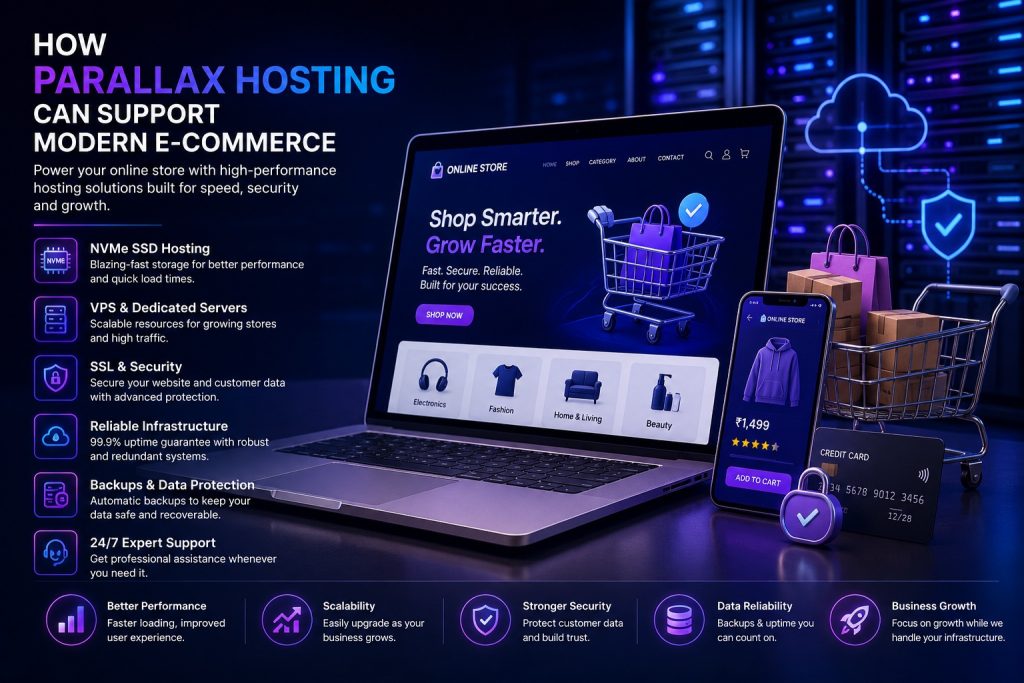
Depending on your website’s size and workload, solutions such as NVMe SSD hosting, VPS hosting, dedicated servers, SSL security, reliable infrastructure, backups, and technical support can help create a stronger foundation for online operations.
The right hosting solution depends on your e-commerce platform, traffic levels, product catalog, database requirements, security needs, and growth plans.
Instead of waiting until your website experiences serious performance problems, businesses should evaluate their infrastructure before major campaigns, seasonal sales, or product launches.
How to Improve E-commerce Website Performance
Hosting is important, but it is only one part of website performance.
Businesses should also optimize the website itself.
Optimize Product Images
Large images can increase page size and slow down loading. Compress product images and use modern formats where appropriate.
Reduce Unnecessary Plugins
Too many plugins can increase processing requirements and create security risks. Remove plugins that are no longer required.
Optimize Your Database
Regularly review database performance, queries, and unnecessary data.
Use Caching
Caching can reduce repeated processing and improve response times for appropriate content.
Use a CDN
A CDN can help distribute static content closer to users, especially when an online store serves customers across different locations.
Minimize Unnecessary Scripts
Third-party tracking, advertising, chat tools, and other scripts can increase page complexity.
Only use tools that provide genuine business value.
Monitor Core Web Vitals
Use tools such as Google Search Console and PageSpeed Insights to identify performance problems.
Security and Performance Must Work Together
Businesses sometimes treat performance and security as separate topics.
In reality, they are connected.
A security system that is poorly configured can create unnecessary friction.
A performance optimization that ignores security can expose the website to risk.
The goal should be to create an infrastructure strategy where:
Security protects the website without unnecessarily slowing legitimate customers.
Modern e-commerce security can include layered application protection, SSL/TLS encryption, bot management, DDoS mitigation, monitoring, and secure server configurations. Cloudflare’s current e-commerce documentation describes this layered approach as a way to protect stores while minimizing friction for legitimate shoppers.
The Future of Online Shopping Is AI-Powered but Trust-Driven
AI can make shopping faster and more personalized, but technology alone cannot create customer trust.
Customers still want:
- Accurate information
- Secure payments
- Reliable delivery
- Transparent policies
- Easy returns
- Responsive support
- Authentic reviews
- A trustworthy brand
This is particularly important as AI-generated recommendations become more common.
Recent research and industry reporting indicate that consumers can find AI recommendations useful while still having concerns about trust, privacy, and how recommendations are generated.
For businesses, the message is clear:
Use AI to improve the customer experience, but do not sacrifice transparency, security, or control.
The E-commerce Infrastructure Checklist for 2026
Before scaling an online store, businesses should ask:
Is the website fast?
Can it handle sudden traffic spikes?
Is the server properly secured?
Are customer connections encrypted with HTTPS?
Are backups available?
Is the database optimized?
Are product pages mobile-friendly?
Are Core Web Vitals being monitored?
Can the infrastructure scale as traffic grows?
Can legitimate search crawlers and AI-related traffic access the site appropriately?
Are malicious bots and abusive traffic being monitored?
Is the hosting provider able to provide timely technical support?
If several answers are “no” or “not sure,” it may be time to review the website’s infrastructure.
Conclusion
Online shopping in 2026 is becoming smarter, faster, more personalized, and more complex.
Artificial intelligence is changing how customers discover products.
Website speed is shaping how customers interact with online stores.
Mobile commerce is making performance more important.
Cybersecurity threats are becoming more sophisticated.
Automated traffic and AI agents are introducing new infrastructure considerations.
Together, these trends are changing what businesses need from their websites.
An e-commerce website is no longer simply a digital catalog.
It is a technology platform that needs to support discovery, personalization, product search, customer accounts, databases, payments, analytics, security, and increasingly sophisticated interactions.
That is why high-performance and secure hosting has become an important part of modern e-commerce strategy.
The strongest approach is not to focus on hosting alone.
Businesses should combine:
High-performance hosting + fast website design + secure infrastructure + mobile optimization + technical SEO + quality content + scalable technology + continuous monitoring.
When these elements work together, an online store is better prepared to attract visitors, deliver a smoother shopping experience, protect customer trust, and support long-term growth.
The question for e-commerce businesses in 2026 is no longer simply:
“Is my online store live?”
The better question is:
“Is my online store fast, secure, scalable, and ready for the future of AI-powered shopping?”
For businesses that want to compete in the next phase of e-commerce, investing in the right infrastructure today can create a stronger foundation for tomorrow.
Frequently Asked Questions
How is AI changing online shopping in 2026?
AI is changing product discovery, recommendations, search, customer support, personalization, and shopping assistance. Customers can increasingly use conversational AI to discover and compare products instead of relying exclusively on traditional search.
Why is website speed important for e-commerce?
Website speed affects how quickly customers can browse products, interact with pages, add items to carts, and complete purchases. Slow pages can create friction and negatively affect the overall shopping experience.
Does hosting affect website speed?
Hosting can affect server response and resource availability, but it is not the only factor. Website code, images, databases, caching, plugins, APIs, and CDN configuration also influence performance.
What is secure e-commerce hosting?
Secure e-commerce hosting is an infrastructure environment designed to support website security through technologies and practices such as HTTPS, SSL/TLS, firewalls, backups, monitoring, malware protection, access controls, and appropriate DDoS and bot protection.
Is VPS hosting good for e-commerce websites?
VPS hosting can be a suitable choice for growing online stores that require more resources and control than basic shared hosting provides. The correct configuration depends on the store’s traffic and technical workload.
Why is NVMe hosting useful for e-commerce?
NVMe SSD storage provides high-speed data access and can be useful for database-driven websites such as online stores. Overall performance still depends on CPU, RAM, database optimization, caching, application architecture, and other factors.
Can AI traffic affect website performance?
Yes. AI-related crawlers, services, integrations, and shopping agents can generate additional requests. Businesses should monitor automated traffic and distinguish legitimate activity from malicious bots.
How can I make my e-commerce website faster?
Start by measuring performance. Optimize product images, reduce unnecessary scripts and plugins, improve database performance, use caching, consider a CDN, optimize your hosting environment, and monitor Core Web Vitals.
Does fast hosting guarantee better Google rankings?
No. Fast hosting does not guarantee higher rankings. Google considers many factors, including relevance, content quality, technical accessibility, and overall page experience. Performance should be treated as one part of a broader SEO strategy.